
Loading countdown timer...
NEW COURSE: Introducing GD&T for Design Design better parts with clear, functional GD&T

Category: GD&T & Print Reading Basics

Articles related to reading engineering drawings and interpreting GD&T on the prints

Flatness or Parallelism

by Crystal Bemis on September 8, 2025.

In this Question Line video, Jason reviews a submitted drawing, explaining the difference between flatness and parallelism, and gives options on how to tolerance the drawing based on what is critical to the design.

Dimensions Identified for Inspection

by Crystal Bemis on June 30, 2025.

What does it mean when a dimension is circled on a drawing—and how does it impact manufacturing? In this video, Jason explains the informal use of ovals as quality control symbols and what it means for how parts are made and inspected.

Rule #1 and Title Block Tolerances

by Crystal Bemis on March 3, 2025.

In this Question Line video, Jason answers a student's question regarding whether a default angular tolerance (found in the Title Block) must be taken into account in addition to the part meeting Rule #1 for it to pass inspection.

Tolerances with Draft

by Crystal Bemis on February 17, 2025.

In this Question Line video, Jason introduces ASME Y14.8 and explains how to apply + or - DRAFT to size dimensions, using examples to show how to find and handle tolerances for draft features.

When to Use GD&T

by Crystal Bemis on October 11, 2024.

In this Question Line video, Jason explains the difference between locating features using GD&T and doing so with traditional coordinate dimensions. He walks through two example drawings to show when to use GD&T and the benefits of it over traditional coordinate dimensions.

Coaxiality vs. Concentricity vs. Position

by Crystal Bemis on October 7, 2024.

In this Question Line video, Jason compares coaxiality, concentricity, and position as defined by the ISO 1101 standard. The ASME Y14.5 interpretation of concentricity and coaxiality is very different from ISO and is not presented in this video.

Understanding Maximum Material Condition

by Crystal Bemis on July 20, 2023.

"Why isn’t Maximum Material Condition always just the largest size the feature can be?” Jason answers our student's question and gives us a delicious way to remember the MMC state in this Question Line Video.

Control on Multiple Profiles

by Crystal Bemis on July 7, 2023.

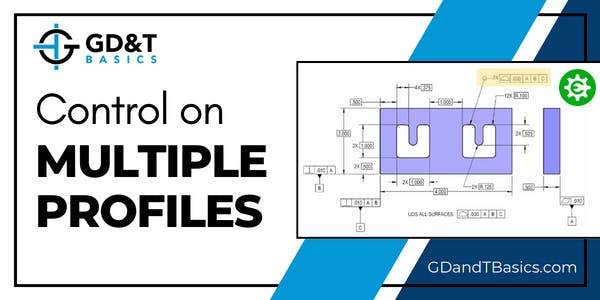
Is it possible to control multiple identical profiles by including a multiplier with the feature control frame? In the video below, Jason reviews a drawing with 2 irregularly shaped identical cutouts to answer this question.

Diametric Tolerance Zones

by Crystal Bemis on June 21, 2023.

In this question line video, we explain when to use the diameter symbol in a feature control frame. The examples below illustrate the unique tolerance zones shapes and sizes for position, perpendicularity, straightness, runout, and cylindricity controls.

Surface Finish and Flatness

by Crystal Bemis on May 15, 2023.

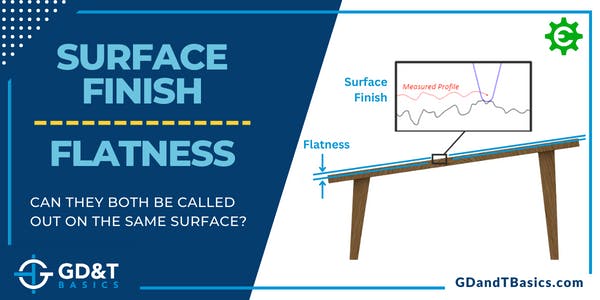
Surface finish and flatness both limit the amount of variation in a surface – one at the micro level and one at the macro level. Is it permissible to call out both on the same surface?

Virtual Condition vs Tolerance Zone

by Crystal Bemis on May 9, 2023.

In our video question line, our GD&T instructors answer questions submitted by our students. In this video, we answer the question, “Is the Virtual Condition the same as the Tolerance Zone?”

Chamfer Dimensioning

by Crystal Bemis on November 10, 2022.

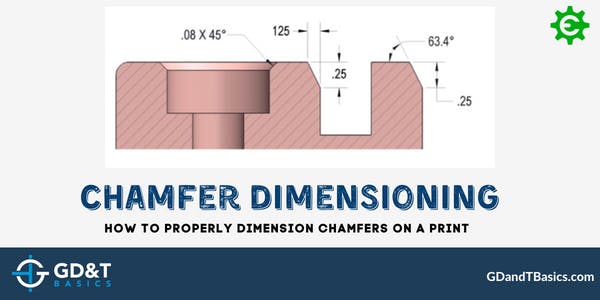
A chamfer is an edge feature commonly seen on part drawings, and consists of an angled cut on an internal or external edge of a part.

Fillets & Rounds

by Crystal Bemis on November 10, 2022.

Fillets and rounds are both radial edge features, with fillets applied to internal edges and rounds applied to external edges.

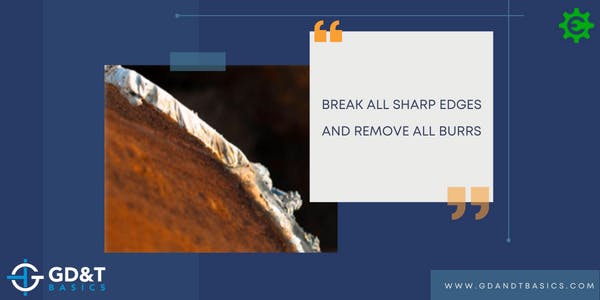
Break Edges Note

by Crystal Bemis on November 10, 2022.

“Break all sharp edges and remove all burrs,” is a common drawing note used to notify the manufacturer that the sharp edges and burrs produced by the manufacturing process must be removed from the part.

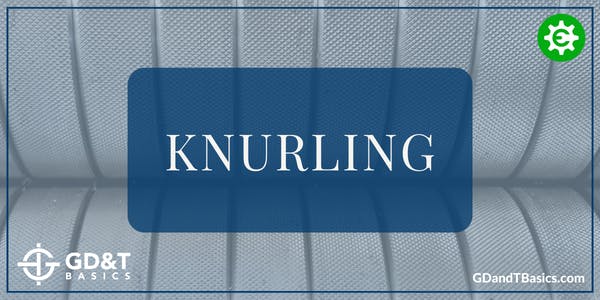
Knurling

by Crystal Bemis on September 19, 2022.

Knurling is a process used to create a pattern on the surface of a material by displacing or deforming the surface.
How Tolerances Impact Machinists?

by Peter Jacobs on August 8, 2022.

Precision tops the list of priorities in CNC machining since being off by a few thousandths is enough to cause serious errors. While no machine yields a 100% accuracy rate, specific approaches have been undertaken to manufacture components efficiently and economically.

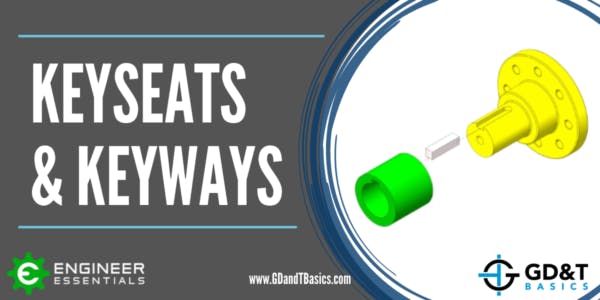
Keyseats and Keyways

by Crystal Bemis on August 1, 2022.

A keyed joint is used to ensure orientation or restrict rotational movement between parts, as in the case of joining a shaft with a coupling. We discuss how a keyed joint is made and inspected in this article.
Restrained Condition Note

by Jason Richter on June 9, 2022.

Some parts, such as those made of rubber or sheet metal, may fail inspection due to deformation from gravity if left in their "free state." This can be prevented by invoking a "restrained state."

Position Tolerance vs “True Position”

by Crystal Bemis on June 8, 2022.

Though many people refer to the GD&T Position symbol as "True Position," they are not the same thing. Read on to learn the difference between Position and True Position and how they work together to define the position of a feature.

Why Use GD&T?

by Crystal Bemis on April 27, 2022. (sticky)

We get a lot of questions from students asking why they would want to use Geometric Dimensioning and Tolerancing (GD&T) over coordinate dimensions. Some believe that using GD&T will result in tighter tolerances and increase...

The Datum Reference Frame

by Crystal Bemis on April 4, 2022.

What is a Datum Reference Frame? Datums are used in Geometric Dimensioning and Tolerancing drawings to create a reference system for inspecting a manufactured part. This reference system is called a Datum Reference Frame (DRF)....

Take our GD&T Skills Assessment Quiz!

by Crystal Bemis on January 28, 2022.

Having a good understanding of Geometric Dimensioning and Tolerancing is very important for anyone working in a mechanical field. GD&T is the language used in design, manufacturing, and quality inspection to communicate on engineering prints....

How Does 1st Angle Projection Work?

by Brandon John on January 19, 2021.

This post is in response to a question that we received on our question line from Gilroy. Gilroy asked us about the drawing projection method in an example problem that was a part of our...

The Basics of Surface Finish

by Seth Elder on January 6, 2021.

Surface finish can be a confusing subject, especially when it comes to units or the difference between Ra and Rz. In this article, we will provide a broad overview and answer some of the most...

Advantages of GD&T vs. Coordinate Tolerancing

by Crystal Bemis on November 6, 2020.

Everyone understands the simple plus or minus tolerances of coordinate dimensioning. So why use GD&T instead? Here are four reasons that GD&T has an advantage over coordinate tolerancing…   What are the advantages of GD&T...