Brandon John has been elbow-deep in manufacturing since the mid-90s — as a machinist, CNC programmer, design engineer, and now Lead Instructor at GD&T Basics. He's a verified ASME Senior-Level GD&T Professional (Credential ID: GDTP S09-8752) and has worked in just about every industry you can think of. His whole thing is making GD&T click for engineers who've been staring at drawings that don't make sense.
Learn the differences between the 2009 and 2018 ASME GD&T exams, explore certification levels, and determine which exam best fits your experience and goals.
Making the decision to invest in GD&T training isn’t always easy. And even once you’ve made that call, you still need to pick a program that’ll teach your team what they need to know. While the concepts...
To determine when to use Profile of a Surface or Coordinate Dimensioning, let’s first look at what the 2009 ASME Y14.5 Geometric Dimensioning and Tolerancing Standard tells us. Paragraph 2.1.1 was revised to emphasize/encourage the...
How are tolerance limits defined? The previous articles in our Intro to Tolerances series have answered the questions, “What is a tolerance?” and “Why use tolerances?” This third and final article in the series explores...
Why use tolerances? In our previous article, “What is a Tolerance?” we introduced the concept of manufacturing tolerances and why they are necessary. In this article, we are going to focus on the benefits of...
What is a tolerance? If you take a look at an engineering drawing, you will notice that there are always limits, or tolerances, placed on a dimension. Why does the designer do this? When a...
The ASME 2018 Y14.5 GD&T Standard contains a few significant changes, including the elimination of the concentricity constraint. Check out this video article for more on this change!
Properly defining, qualifying, and referencing datum features is essential to ensure that parts are properly manufactured and inspected. To begin exploring proper use of datum features, it is helpful if we first review definitions and...
There can be a lot of confusion when dealing with circularity – especially when identifying the tolerance zone compared to how Rule #1 of Geometric Dimensioning and Tolerancing controls it. In this video, we provide...
In this video, Brandon discusses basic dimensions and why they should not be recorded on an inspection report. What Are Basic Dimensions? Basic dimensions are used in Geometric Dimensioning and Tolerancing to describe the theoretically...
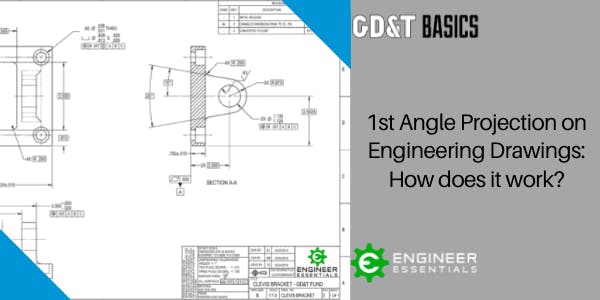
This post is in response to a question that we received on our question line from Gilroy. Gilroy asked us about the drawing projection method in an example problem that was a part of our...
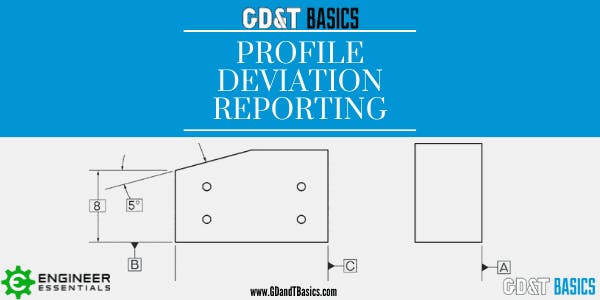
This video is in response to a question that we received on our question line from Brandon. The question is as follows: “I have profile tolerance on a flat surface of 0.2 mm with respect...
In this video, Brandon compares a Composite Feature Control Frame and a Multiple Single Segment Feature Control Frame to show the effect of each on Position tolerance. What is a Composite Feature Control Frame? A...
There are many great reasons why engineers & designers benefit from knowledge of Geometric Dimensioning & Tolerancing (GD&T). But today, we want to share with you just one reason that is particularly interesting. Even though...
We would like to shed light on an interesting discussion stemming from a question asked in our Print Reading and Tolerances Course. A student shared their viewpoint about the correct use of centerlines in engineering...
In this question line video, Brandon outlines the pitfalls of Chain Dimensioning and explains how Baseline Dimensioning (or GD&T) can eliminate potentially unwanted tolerance stack. Chain Dimensioning is when dimensions are drawn from one feature...