
Go/No-Go Gaging and Rule #1
In this Question Line video, Brandon explains how a go gage and no-go gage are used to verify that Rule #1 of GD&T is met for a feature of size.

As our Training Design Engineer at GD&T Basics, Jason Richter is responsible for creating and maintaining lessons and visual content for our courses and YouTube page, as well as hosting our GD&T Public Training Seminars.
Jason discusses how to select the appropriate datum feature when designing a hollow cylindrical part where both the ID and OD are mating features.
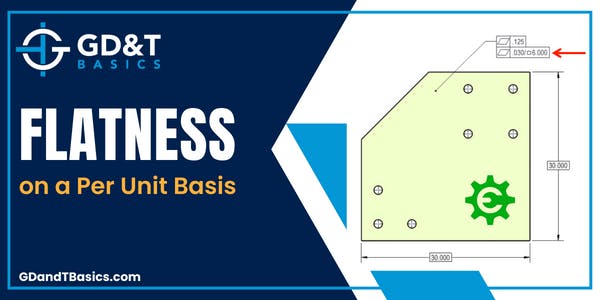
Jason discusses form controls on a per unit basis using the example of controlling flatness on a large surface in this Question Line Video.
Jason walks through drawing examples to explain how to tell at a glance whether a drawing is using inch or metric dimensions.
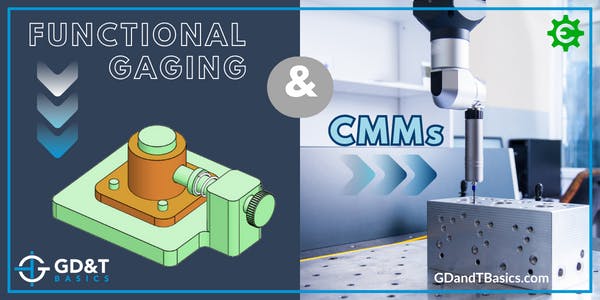
In this Question Line video, Jason compares the use of functional gages and CMMs for inspection and discusses benefits and drawbacks of each.
Jason answers a student’s question regarding whether a feature of size can be designed to both MMC and LMC boundary constraints.
In this Question Line Video, Jason uses the example of a cylindrical datum feature to show how non-planar datums can be simulated and how they are able to constrain degrees of freedom.
In this Question Line Video, Jason reviews a drawing example and compares the ASME and ISO standards for controlling a hole with position tolerance.
"Why isn’t Maximum Material Condition always just the largest size the feature can be?” Jason answers our student's question and gives us a delicious way to remember the MMC state in this Question Line Video.
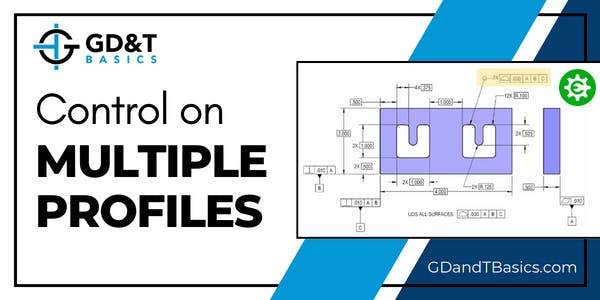
Jason reviews a drawing with two identical cutouts to show whether multiple profiles can be controlled by including a multiplier with the feature control frame.
In this question line video, we explain when to use the diameter symbol in a feature control frame. The examples below illustrate the unique tolerance zones shapes and sizes for position, perpendicularity, straightness, runout, and cylindricity controls.
Can you use the MMC modifier and still ensure a minimum wall thickness? To answer this question, we are going to look at a drawing of a flywheel and compare how using the MMC modifier or the LMC modifier affects the minimum wall thickness.
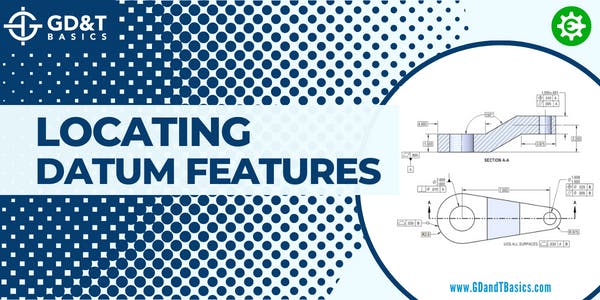
Why doesn't a feature of size that is indicated as a datum feature need to be located? In this article and corresponding question line video, we look at two drawing examples to illustrate why datum features are not located.
"Why doesn’t Rule #1 apply to the straightness of a Derived Median Line?" In this article, we look at both surface straightness and straightness of a feature of size to understand why Derived Median Line Straightness overrules Rule #1 of GD&T.
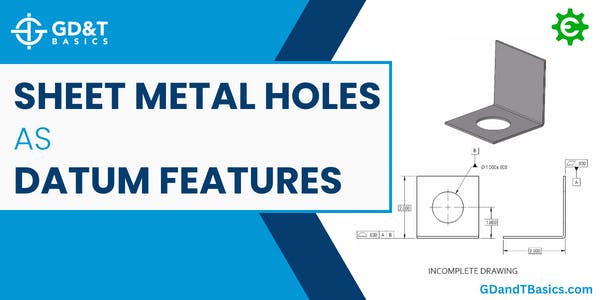
If I specify a hole in a practically thin feature, such as a piece of sheet metal, is this still considered a cylindrical datum? Is this a poor choice of datum? In this article, we look at an example to help us answer these questions.
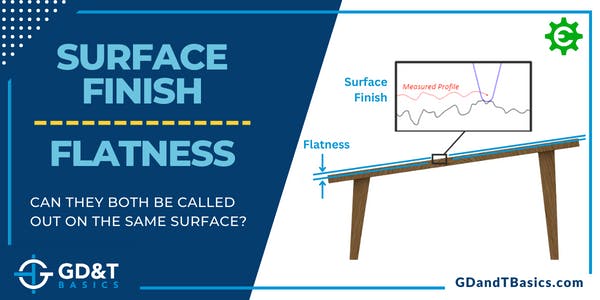
Surface finish and flatness both limit the amount of variation in a surface – one at the micro level and one at the macro level. Is it permissible to call out both on the same surface?
In our video question line, our GD&T instructors answer questions submitted by our students. In this video, we answer the question, “Is the Virtual Condition the same as the Tolerance Zone?”
Molly Olson is one of our expert GD&T Instructors, with a wealth of valuable real-world experience in quality control and inspection. She has spent nearly 20 years as a Quality Inspector and CMM Programmer and Operator across several different industries, including aerospace, firearms, robotics, and prosthetics.
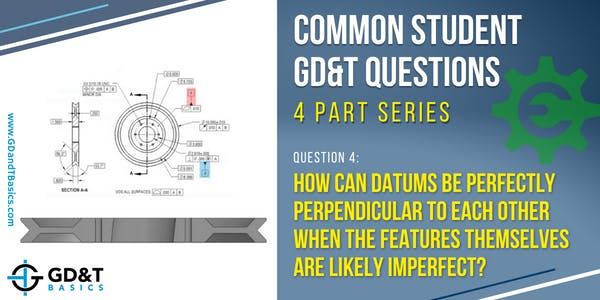
How can datums be perfectly perpendicular to each other when the features themselves are likely imperfect? The feature axis and the datum axis derived from the feature are found in two different ways, using the Unrelated Actual Mating Envelope and the Related Actual Mating Envelope.
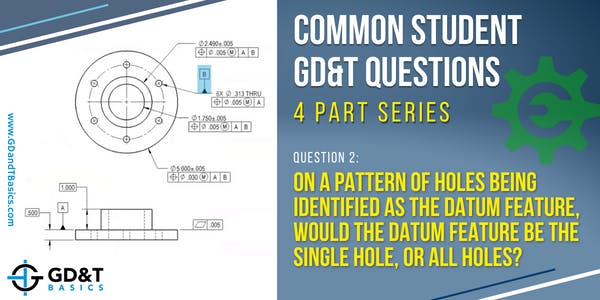
We often see a pattern of holes indicated as a datum feature in a GD&T drawing. How do we simulate this to create our datum reference frame?
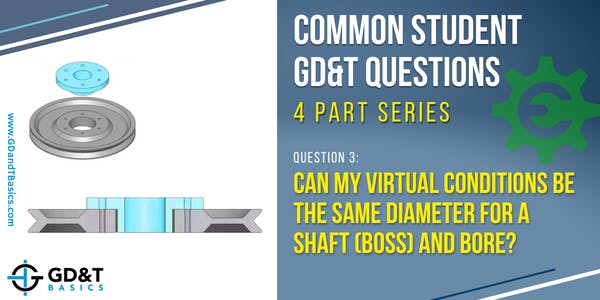
Is it allowable to have identical Virtual Conditions for mating boss and bore features? Learn how to calculate and compare Virtual Conditions of mating features to understand the potential clearance between the assembled parts.
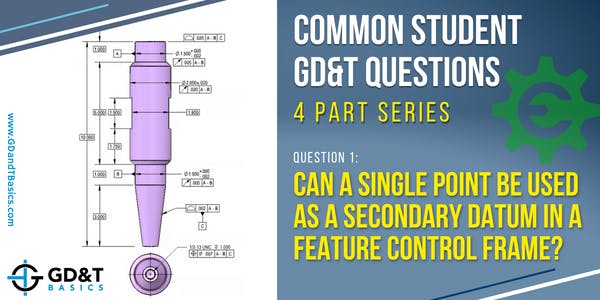
Can a single point (without clocking) be used as a secondary datum in a feature control frame? To answer this question, we first need to determine what datum feature is being represented by this single point. Read on to discover the answer to this commonly asked question from our GD&T students.
When applying position tolerances to countersunk fixed fastener assembly conditions, our design must not only ensure assembly, but also that the fastener head sits flush or below the surface of the part. We are able to determine the values required to achieve this by using the fixed fastener equation.
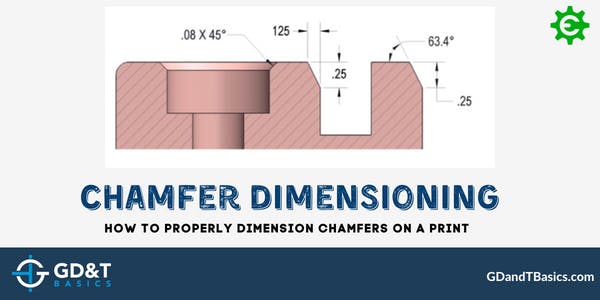
A chamfer is an edge feature commonly seen on part drawings, and consists of an angled cut on an internal or external edge of a part.
Fillets and rounds are both radial edge features, with fillets applied to internal edges and rounds applied to external edges.
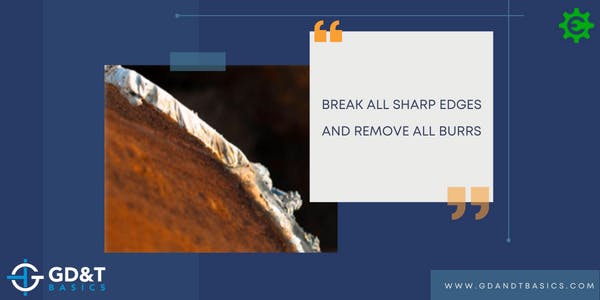
“Break all sharp edges and remove all burrs,” is a common drawing note used to notify the manufacturer that the sharp edges and burrs produced by the manufacturing process must be removed from the part.
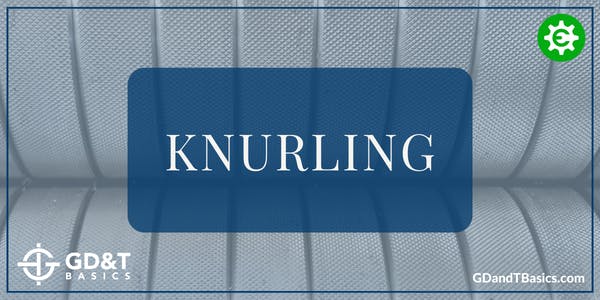
Knurling is a process used to create a pattern on the surface of a material by displacing or deforming the surface.
To understand the thread requirements on your drawing, you need to know common standard thread information. In this article, we will be discussing thread diameters, threads per inch and thread pitch.
A keyed joint is used to ensure orientation or restrict rotational movement between parts, as in the case of joining a shaft with a coupling. We discuss how a keyed joint is made and inspected in this article.
In this article, we outline the basic process for adding GD&T to your drawing using SolidWorks. The accompanying video goes into full detail, walking through the entire process for an example drawing.
Though many people refer to the GD&T Position symbol as "True Position," they are not the same thing. Read on to learn the difference between Position and True Position and how they work together to define the position of a feature.
Tolerance stacks can be a nightmare. However, when using GD&T rather than coordinate dimensioning, tolerance stack-ups within a part can be avoided.
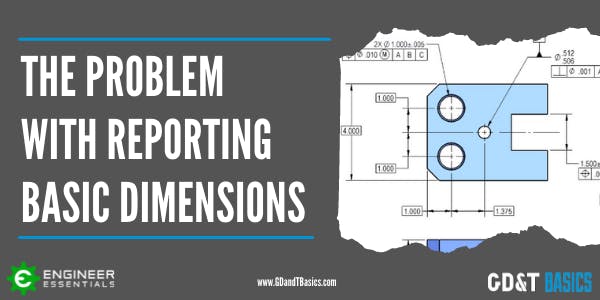
In Geometric Dimensioning and Tolerancing, Basic Dimensions are theoretically exact dimensions that define the ideal exact location and orientation of surfaces and features of size. A basic dimension is shown on a drawing as a...

We get a lot of questions from students asking why they would want to use Geometric Dimensioning and Tolerancing (GD&T) over coordinate dimensions. Some believe that using GD&T will result in tighter tolerances and increase...
What is a Datum Reference Frame? Datums are used in Geometric Dimensioning and Tolerancing drawings to create a reference system for inspecting a manufactured part. This reference system is called a Datum Reference Frame (DRF)....
Having a good understanding of Geometric Dimensioning and Tolerancing is very important for anyone working in a mechanical field. GD&T is the language used in design, manufacturing, and quality inspection to communicate on engineering prints....
The most common way to produce an internal thread is to drill a hole and then use a tap to produce the thread. This is usually referred to as a tapping drill for the size...
GD&T Basics has partnered with Mitutoyo to demonstrate how to set up and inspect a part using a CMM. In this video, we examine a part designed as a training aid by Mitutoyo, inspecting it...
What is the difference between the ISO and ASME GD&T standards? Read on to find the answers to these questions and more – and see our GD&T Standards Comparison Chart available to download for free below....