Tag: GDandT Symbol

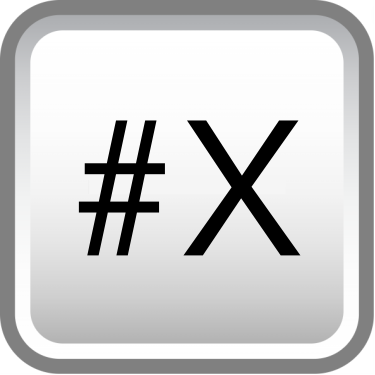
Multiple Identical Features

by Crystal Bemis on January 4, 2024.

The #X designator is used to prevent redundant dimensions when a print has multiple identical features or a pattern. The number placed in front of the X represents the number of repetitive features that the dimension applies to.
Slope

by Crystal Bemis on February 15, 2023.
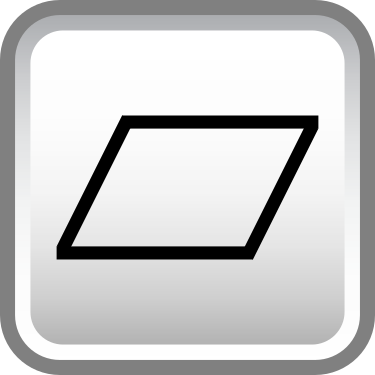
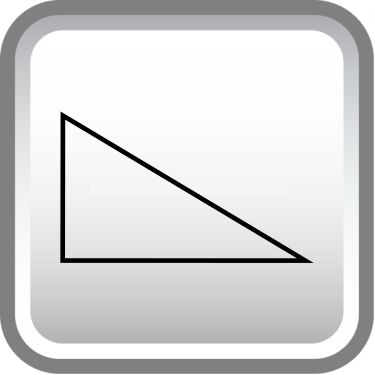
The slope modifying symbol is placed with a value to indicate that this value is controlled as a slope, or a “flat taper.” The value listed with the symbol is the ratio of the height change to length change.

Conical Taper

by Crystal Bemis on February 6, 2023.

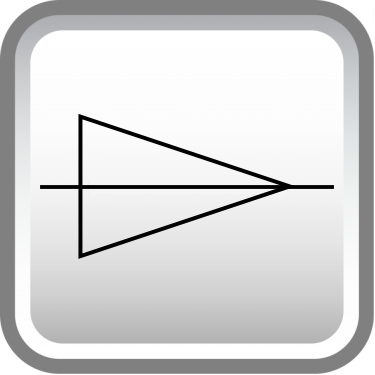
The conical taper symbol is placed with a dimension value to indicate that the value is controlled as a standard taper. The value listed with the symbol is the ratio of the diameter change to length change.

Arc Length

by Crystal Bemis on January 5, 2023.

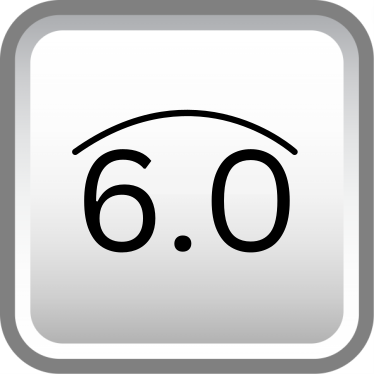
The Arc Length symbol, also known as the Arc Modifying symbol, is placed above a value to indicate that the arc’s length is being dimensioned on a curved outline. 

Parting Line

by Crystal Bemis on January 5, 2023.

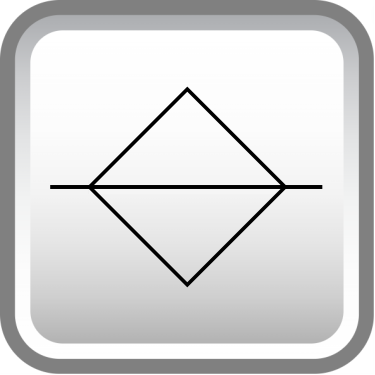
A parting line is the location where separate parts of a mold or die come together. If the parting line is not dimensioned on the drawing, the location of the parting line is up to the manufacturer’s discretion.

Dimension Origin

by Crystal Bemis on December 14, 2022.

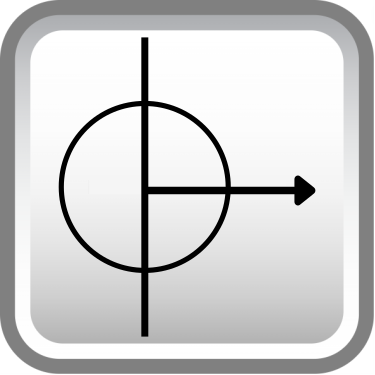
The dimension origin symbol is used to indicate where a dimension must be measured from. This symbol is used in place of a dimensional arrow leader to indicate the origin for measurement.

Depth Symbol

by Crystal Bemis on December 1, 2022.

The depth symbol is used to indicate a measurement from the bottom of a feature to the outer surface of a part.

Spherical Diameter

by Crystal Bemis on October 10, 2022.

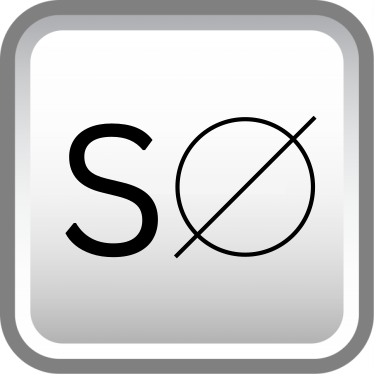
The Spherical Diameter symbol is used to indicate that the Diameter is of a spherical, rather than circular, feature.

Diameter

by Crystal Bemis on October 4, 2022.

The diameter symbol is used to indicate that the size of a circular feature is being dimensioned using the diameter of that feature.

Controlled Radius

by Crystal Bemis on October 4, 2022.

The Controlled Radius symbol is a variation of the Radius, and is used when the surface of the contour is required to be a "fair" curve.

Spherical Radius

by Crystal Bemis on September 29, 2022.

The Spherical Radius is used to indicate that the Radius is of a spherical, rather than circular, feature.

Square

by Crystal Bemis on September 29, 2022.

The Square symbol is used to indicate a square feature on a drawing.

Radius

by Crystal Bemis on September 28, 2022.

The Radius symbol is used when a circular feature is dimensioned using the radius length.

Countersink

by Crystal Bemis on September 7, 2022.

A countersink consists of a conical hole that is coaxial to a cylindrical hole, where the angle of the cone is determined by the fastener to be used. The purpose of a countersink is to allow a fastener, typically a flathead screw, to sit slightly below the surface of the part.

Spotface

by Crystal Bemis on September 7, 2022.

A spotface is a very shallow flat-bottomed cylindrical hole that is larger than and coaxial to another cylindrical hole. Its purpose is to provide a flat mounting surface for mating parts, such as washers or pan head screws.

Counterbore

by Crystal Bemis on August 9, 2022.

The counterbore symbol is used on a drawing to indicate that a counterbore hole feature is required. A counterbore is a flat-bottomed cylindrical hole that is larger than and coaxial to another cylindrical hole.

Tangent Plane

by Jason Richter on July 8, 2022.

The Tangent Plane Symbol is used in conjunction with GD&T surface controls to indicate that a specific control is applied to a theoretical tangent plane simulated by the high points of irregular tangible surface rather than the actual elements of the surface themselves.

Free State Symbol

by Jason Richter on June 8, 2022.

The Free State Symbol is in used GD&T to indicate that a specific dimension and its associated tolerance are to be assessed in an unrestrained state.

Projected Tolerance Zone

by Jason Richter on June 6, 2022.

The Projected Tolerance Symbol is in used GD&T to indicate the tolerance zone of a feature is to be assessed beyond the surface extents of the feature.

Continuous Feature

by Jason Richter on May 17, 2022.

The Continuous Feature Symbol is used to indicate that a group of disjointed features or surfaces are to be considered as one continuous feature.

Datum Target

by Jason Richter on March 28, 2022.

The Datum Target Symbol is used to define a specific point, line, or area to be used in order to establish a datum on a drawing.

Independency

by Jason Richter on March 9, 2022.

The Independency Symbol is used on drawings to declare that the requirement for perfect form at MMC or LMC is removed and the form tolerance may be larger than the size tolerance. This symbol only exists in the ASME Y14.5 standards, not the ISO GPS standards.

True Position – Position Tolerance

by GD&T Basics on December 22, 2014.

Position is one of the most useful and most complex of all the symbols in GD&T. The two methods of using Position discussed on this page will be RFS or Regardless of Feature Size and under a material condition (Maximum Material Condition or Least Material Condition). Position is always used with a feature of size.

Circularity

by GD&T Basics on December 21, 2014.

The circularity symbol is used to describe how close an object should be to a true circle...

Parallelism

by GD&T Basics on December 20, 2014.

Parallelism is a fairly common symbol that describes a parallel orientation of one referenced feature to a datum surface or line...

Cylindricity

by GD&T Basics on December 18, 2014.

The Cylindricity symbol is used to describe how close an object conforms to a true cylinder...

Profile of a Surface

by GD&T Basics on December 18, 2014.

Profile of a surface describes a 3-Dimensional tolerance zone around a surface, usually which is an advanced curve or shape...

Runout

by GD&T Basics on December 16, 2014.

Runout is how much one given reference feature or features vary with respect to another datum when the part is rotated 360° around the datum axis.

Concentricity

by GD&T Basics on December 15, 2014.

Concentricity, is a tolerance that controls the central derived median points of the referenced feature, to a datum axis. Concentricity is a very complex feature because it relies on measurements from derived median points as opposed to a surface or feature’s axis.

Perpendicularity

by GD&T Basics on December 14, 2014.

Perpendicularity is a fairly common symbol that requires the referenced surface or line to be perpendicular or 90° from a datum surface or line...

Total Runout

by GD&T Basics on December 13, 2014.

Total Runout is how much one entire feature or surface varies with respect to a datum when the part is rotated 360° around the datum axis...

Profile of a Line

by GD&T Basics on December 2, 2014.

Profile of a line describes a tolerance zone around any line in any feature, usually of a curved shape...

Angularity

by Tom Geiss on November 7, 2014.

Angularity is the symbol that describes the specific orientation of one feature to another at a referenced angle...

Straightness

by Tom Geiss on November 6, 2014.

The standard form of straightness is a 2-Dimensional tolerance that is used to ensure that a part is uniform across a surface or feature. Straightness can apply to either a flat feature such as the surface of a block, or it can apply to the surface of a cylinder along the axial direction. It is defined as the variance of the surface within a specified line on that surface.

Symmetry

by Tom Geiss on November 4, 2014.

GD&T Symmetry is a 3-Dimensional tolerance that is used to ensure that two features on a part are uniform across a datum plane...

Flatness

by Tom Geiss on November 3, 2014.

GD&T Flatness is a common symbol that references how flat a surface is regardless of any other datum’s or features. It comes in useful if a feature is to be defined on a drawing that needs to be uniformly flat without tightening any other dimensions on the drawing. The flatness tolerance references two parallel planes (parallel to the surface that it is called out on) that define a zone where the entire reference surface must lie.