In this question line video, Brandon reviews the differences between the GD&T callouts for circularity, circular runout, and total runout. To examine the differences in these concepts it is helpful to first review the Geometric...
Does Runout or Size Control the Circularity/Form Error in GD&T? (Answer: It Depends) In this article video, we aim to answer how Runout is used to control the form/shape/circularity/cylindricity on a cylinder. It also...
Check out this question brought up about Flatness in our GD&T Fundamentals Course. We get a lot of questions about when flatness can be applied and how datums can be used with this. There are...
A datum is theoretical exact plane, axis or point location that GD&T or dimensional tolerances are referenced to. You can think of them as an anchor for the entire part; where the other features are referenced from. A datum feature is usually an important functional feature that needs to be controlled during measurement as well.
Position is one of the most useful and most complex of all the symbols in GD&T. The two methods of using Position discussed on this page will be RFS or Regardless of Feature Size and under a material condition (Maximum Material Condition or Least Material Condition). Position is always used with a feature of size.
Concentricity, is a tolerance that controls the central derived median points of the referenced feature, to a datum axis. Concentricity is a very complex feature because it relies on measurements from derived median points as opposed to a surface or feature’s axis.
Maximum Material Condition (MMC), is a feature of size symbol that describes the condition of a feature or part where the maximum amount of material (volume/size) exists within its dimensional tolerance.
Least material condition is a feature of size symbol that describes a dimensional or size condition where the least amount of material (volume/size) exists within its dimensional tolerance...
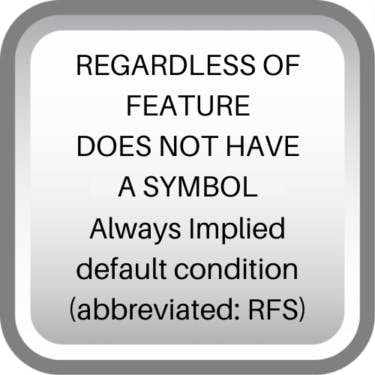
Regardless of feature size simply means that whatever GD&T callout you make, is controlled independently of the size dimension of the part. RFS is the default condition of all geometric tolerances by rule #2 of GD&T and requires no callout.
The standard form of straightness is a 2-Dimensional tolerance that is used to ensure that a part is uniform across a surface or feature. Straightness can apply to either a flat feature such as the surface of a block, or it can apply to the surface of a cylinder along the axial direction. It is defined as the variance of the surface within a specified line on that surface.