
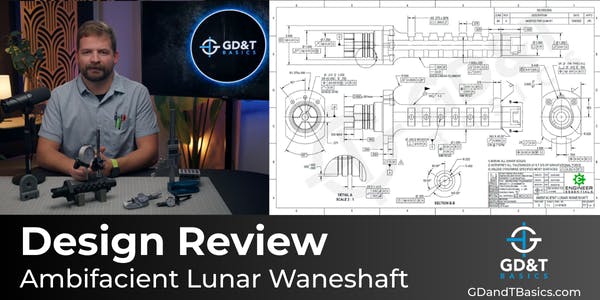

Download the Drawing:
To follow along with the review, download the Ambifacient Lunar Waneshaft drawing used in the video: 👉 Download the PDF
___________________________________________________________________
Clear communication of design intent is critical when dealing with complex components, especially when multiple teams are responsible for design, manufacturing, and inspection.
In this review, Jason walks through the design of the Ambifacient Lunar Waneshaft for the Turboencabulator, focusing on how GD&T is used to apply tolerances, define datum reference frames, and communicate functional requirements. The discussion examines how design decisions impact manufacturability, inspection strategy, and downstream interpretation of the drawing.
Throughout the walkthrough, the drawing is evaluated using practical GD&T principles, including position and profile controls, datum structure selection, and tolerance application relative to functional behavior. The review also highlights how DFM considerations influence tolerancing choices and how ambiguity in drawings can create unnecessary challenges for manufacturing and quality teams.
This example illustrates the importance of applying tolerances with intent—not simply to constrain geometry, but to clearly communicate how a part is expected to function and be verified in the real world.
Watch the Design Review:
Reference Material:
Original inspiration for this video: https://www.youtube.com/watch?v=2fjcJp_Nwvk
Stop hunting through pages. Get our GD&T Symbols Chart—your quick reference guide with every symbol on one page.
Save it to your desktop or print it out for quick reference. We’ll send the digital chart straight to your inbox. No spam, just helpful GD&T resources.
Get Your Free Chart