
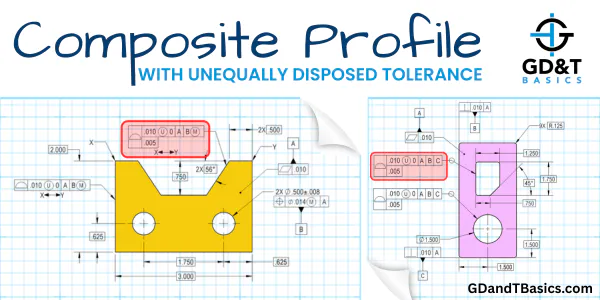

In this Question Line video, Jason answers the following submitted question regarding composite profile with unequally disposed tolerance:
A customer has recently submitted a drawing using a composite profile tolerance. The upper control having a unilateral tolerance and the lower bilateral.
My interpretation is that I’m unable to make use of the positive portion of the bilateral [0.05] profile tolerance because the part would never be able to fall within the unilateral [0.1 Ⓤ 0]. I have, however, been told that I can make use of that portion of the tolerance because the [0.05] can float within the [0.1 Ⓤ 0]. Which I wouldn’t think was possible considering the extents of [0.05] lie outside of [0.1 Ⓤ 0].
Jason walks through two examples to clarify how composite profile with unequally disposed tolerances works:
Example 1: This drawing includes a composite profile control where the top frame of the feature control frame contains 0.010 total tolerance, unequally disposed with 0 lying outside of the part, in reference to Datums A and B. The bottom frame refines the top frame with a lower tolerance of 0.005 with no datums referenced. This composite profile control is being applied between points X and Y.
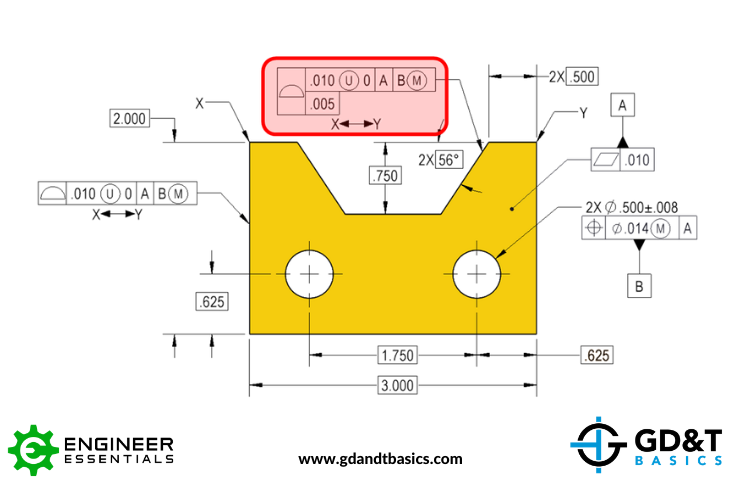
Example 1: Composite Profile Control Applied Between Points X & Y
Example 2: This drawing includes a similar composite profile control, however, the tolerance is being applied to a continuous surface all around, rather than between two points.
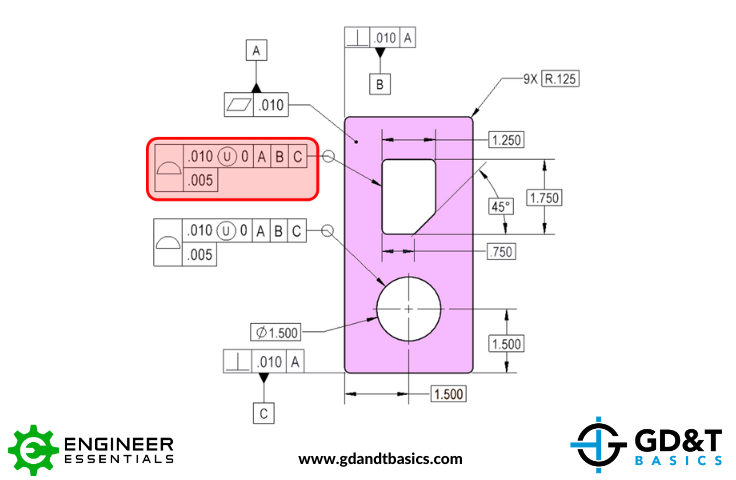
Example 2: Composite Profile Control Applied to a Continuous Surface
For these examples, Jason explains how the tolerance zones interact to control the profile’s location, orientation, and form. He also discusses why unequally disposed profiles are used – and when they might not offer any benefit.
For more information on composite controls:
For more information on unequally disposed profile:
Have a GD&T question? Ask our instructors using the link below!
https://www.gdandtbasics.com/share-your-gdt-questions/
If your question is selected, we will notify you when our video answer is posted to our YouTube channel.
* If you are a current student, reach out to us directly and we will get you into contact with your instructor. Active students’ questions receive a direct response within 24-48 hours.
The one-page GD&T reference that you will use every day
A visual breakdown of every core GD&T symbol and what it controls, all on one page. Bookmark it. Print it. Actually use it.
Download the Chart