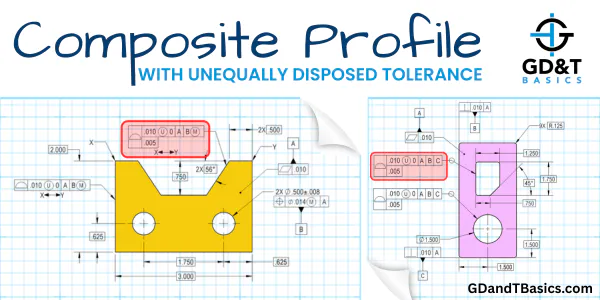
In this Question Line video, Jason walks through two examples of composite profile with unequally disposed tolerance zones, discussing why and when they should be used and explaining how the zones interact to control location, orientation, and form.
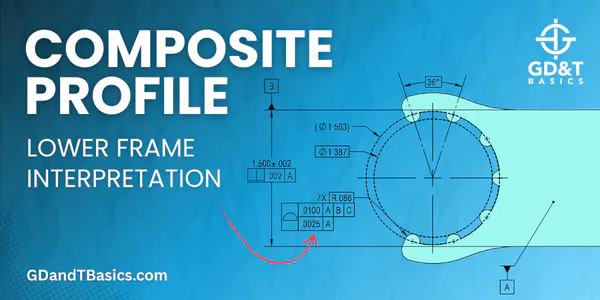
Jason walks through tolerance analysis for a profile control and shows how the feature control frame defines the location and orientation of the tolerance zone.
In this Question Line video, Jason reviews a submitted drawing that attempts to locate two parts relative to each other and explains how to choose the correct GD&T tolerances to support the intended function.
In this Question Line video, Jason discusses applying tolerances to fillets and rounds, explaining why applying profile of a surface allows more direct control of the size and form than using +/- tolerances.
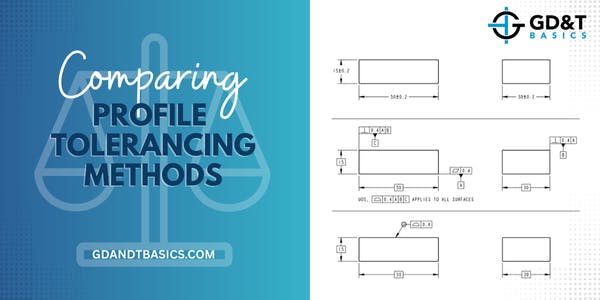
In this Question Line video, Jason walks through a few examples to show us the difference between profile of a surface with and without datums referenced in the feature control frame and how that affects the reported deviation.
In this Question Line video, Jason discusses the ISO Unequal Zone (UZ) modifier, which is similar to the Unequally Disposed modifier of the ASME standard. He walks through an example where the UZ modifier is included in a feature control frame controlling profile of a surface and discusses how this impacts the tolerance zone.
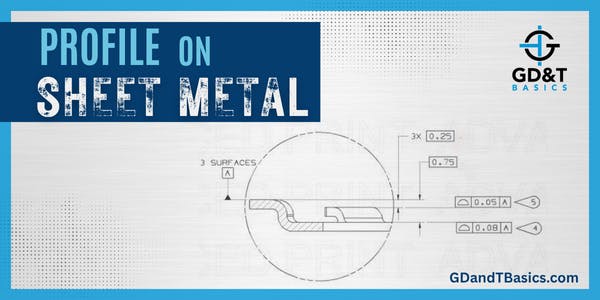
In this Question Line video, Jason discusses size dimensions to avoid with stepped surfaces and how datums and profile eliminate ambiguous dimensioning.
Coordinate Measuring Machines (CMMs) are essential tools for obtaining precise measurements. However, to ensure accurate measurements, it is crucial to understand how to use them correctly. In this video, Jason explains the importance of recognizing and utilizing appropriate vectors when inspecting a profile or irregular surface with a CMM probe.
Jason reviews a drawing with two identical cutouts to show whether multiple profiles can be controlled by including a multiplier with the feature control frame.
What is the difference between unilateral and bilateral tolerance in a profile of a surface callout? In this post, Brandon explains the difference and gives examples of how they are used. Profile of...