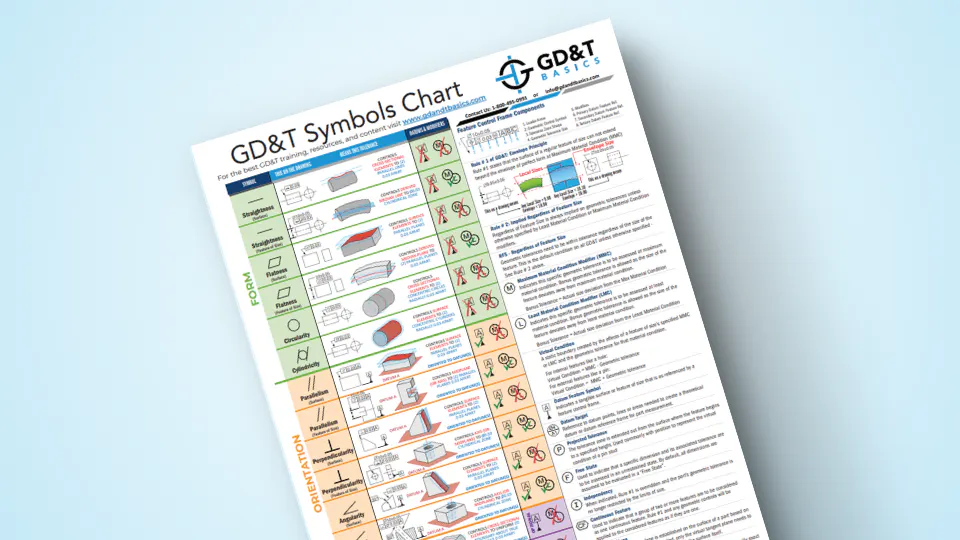
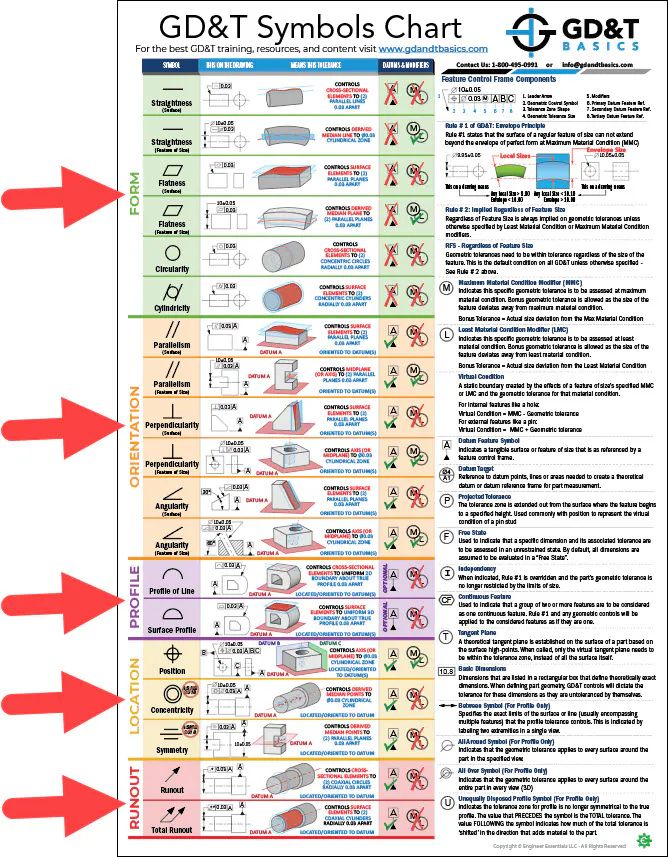
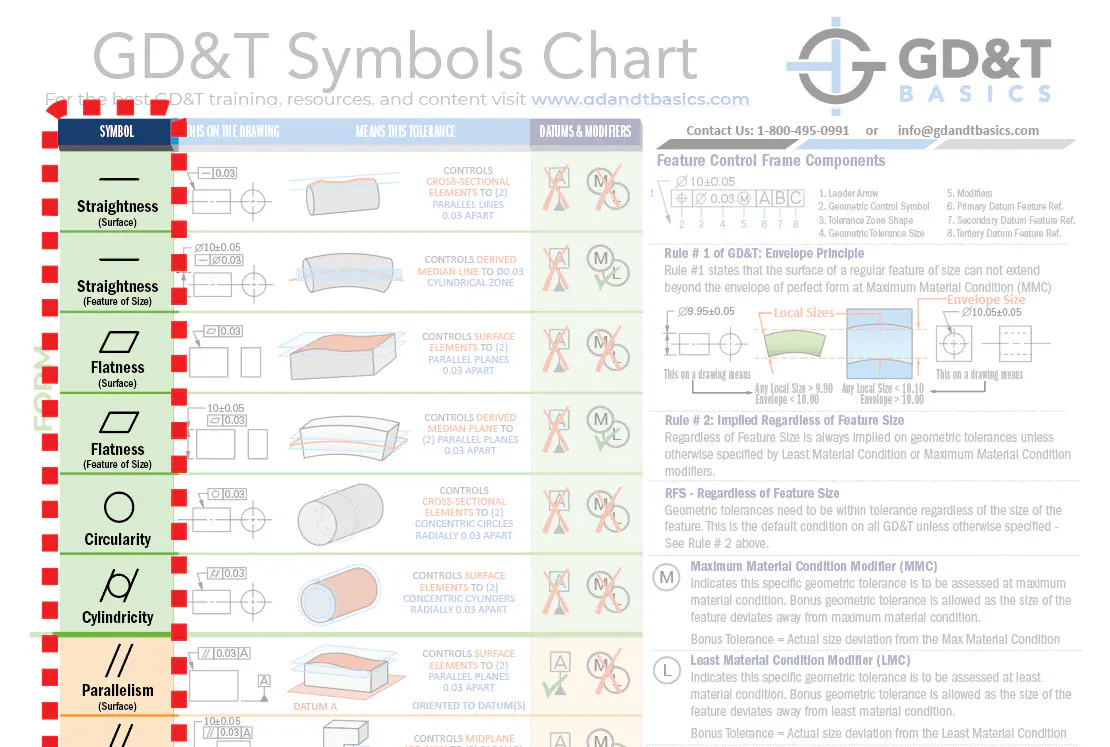
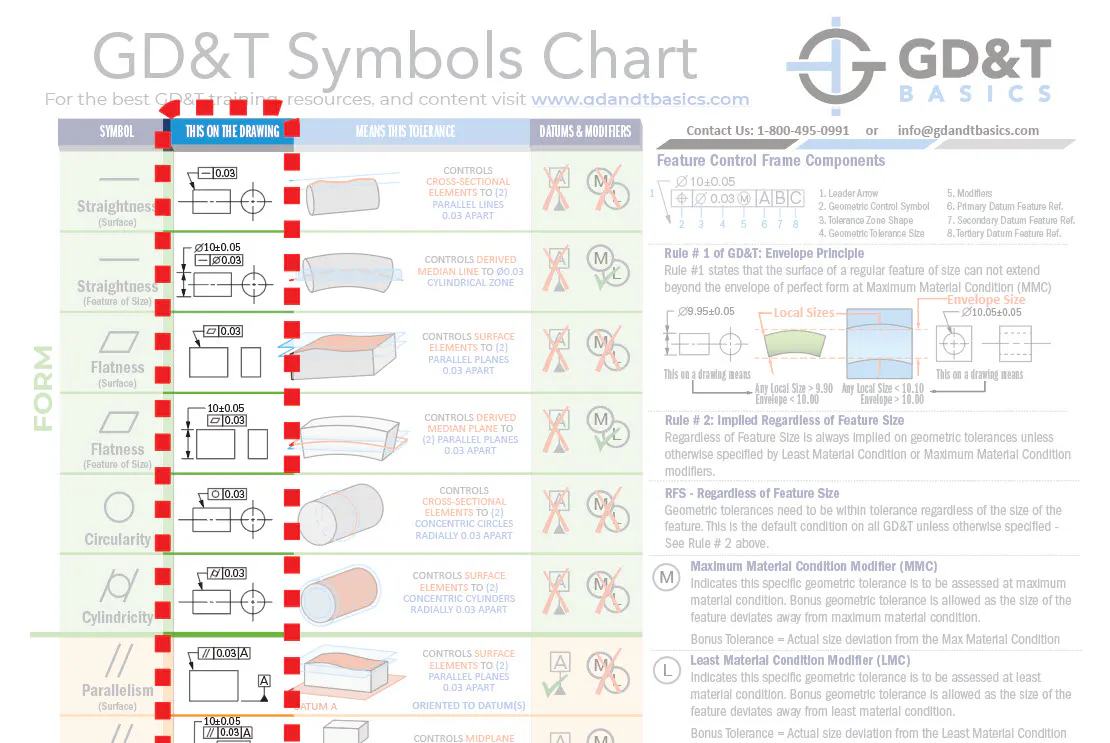
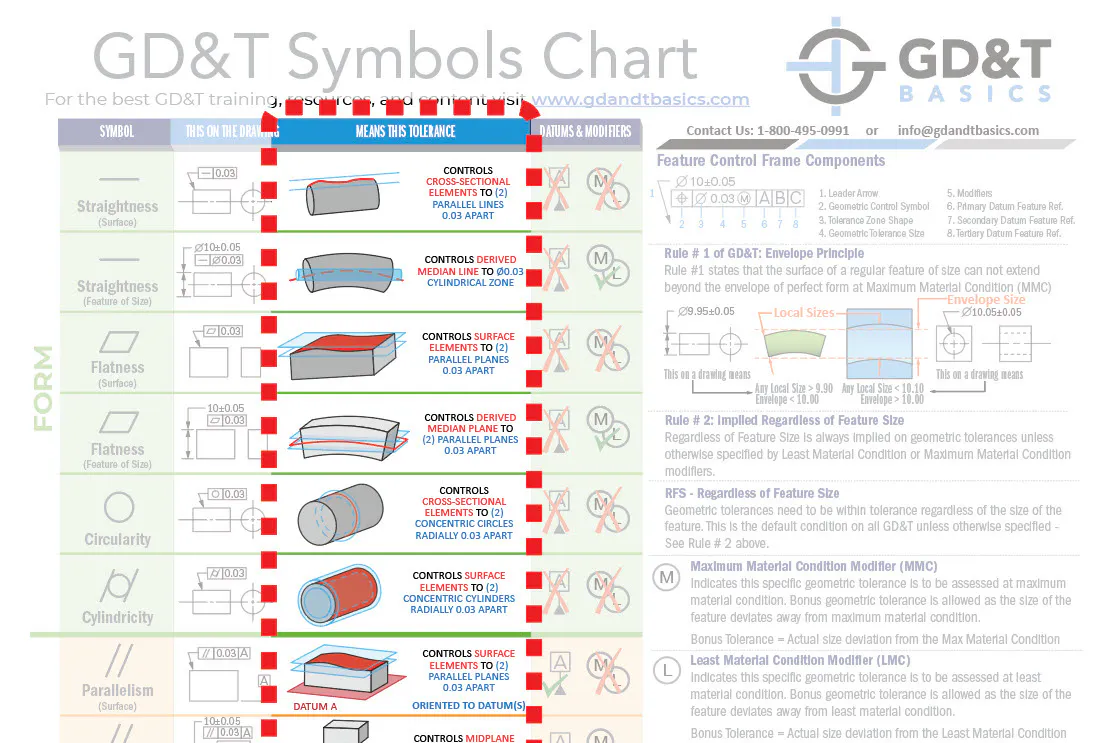
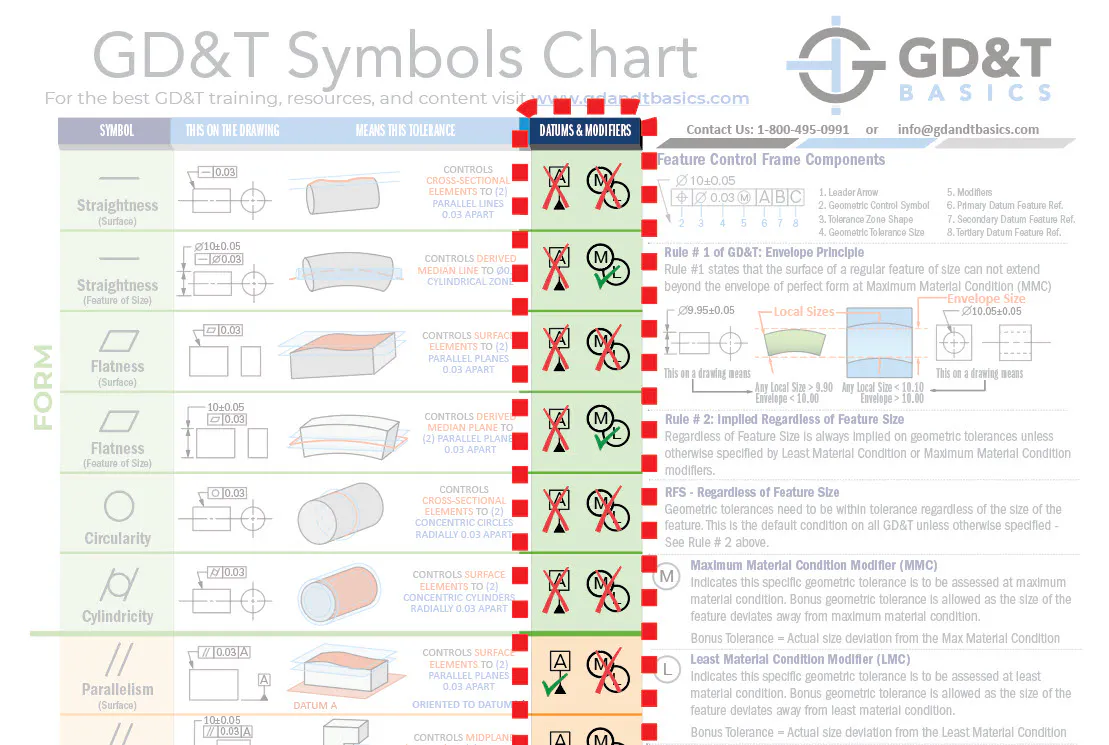
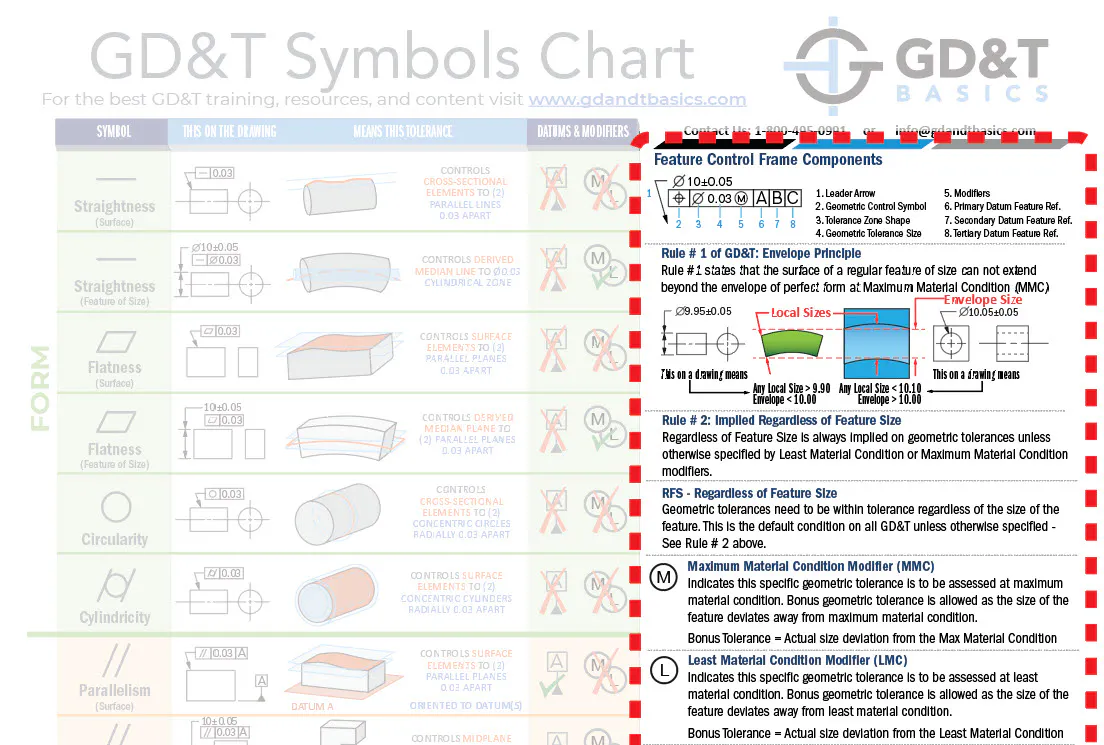
The main chart covers all 14 GD&T tolerance controls, organized into five categories based on what they control. Once you know which category a symbol falls into, you already know something about what it does.
Form Controls
Green rows · Straightness, Flatness, Circularity, Cylindricity
Control the shape of a feature by itself — no datums required. These form controls will never reverence any datums. These tolerances only care about the feature’s own geometry, not where it sits on the part.
Orientation Controls
Orange rows · Parallelism, Perpendicularity, Angularity
Control how a feature is angled relative to a datum. At least one datum is always required — these controls are meaningless without something to be parallel, perpendicular, or angled to. Orientation controls do not locate a feature; they only control its angle.
Profile Controls
Purple rows · Profile of a Line, Profile of a Surface
Control the shape of a surface or cross-section relative to a true profile. Profile of a Surface is one of the most versatile controls in GD&T — it can simultaneously control form, orientation, and location in a single callout. Datums are optional but common.
Location Controls
Yellow rows · Position, Concentricity, Symmetry
Control where a feature is located relative to datums. Position is the most widely used control in GD&T — it defines where a hole, slot, boss, or tab must fall within a tolerance zone (even controls spheres!). Datums are always required (unless youre controlling a pattern of features and dont care where that pattern ends up).
Note: Concentricity and Symmetry were removed from ASME Y14.5-2018. If you’re working to the 2018 standard, Consider using other controls like Position or Runout instead. Concentricity and Symmetry are still valid on drawings that reference an older revision — always check the title block.
Runout Controls
Red rows · Runout, Total Runout
Control how much a surface wobbles around a datum axis during rotation. Measured by spinning the part and inspecting the surface with a dial indicator. The go-to controls for shafts, bearings, and any rotating components.