What is GD&T?
What is GD&T? Learn what geometric dimensions and tolerances are and how their tolerance zones differ from traditional numerical ± limits.
Geometric Dimensioning and Tolerancing, and the concept of “True Position,” originated due to a rejection of functional parts as a result of coordinate dimensioning. Let’s look at a simple assembly to illustrate why this is true, and how GD&T Position takes care of this problem.
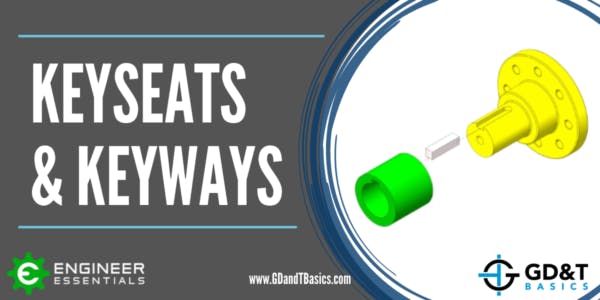
A keyed joint is used to ensure orientation or restrict rotational movement between parts, as in the case of joining a shaft with a coupling. We discuss how a keyed joint is made and inspected in this article.
Everyone understands the simple plus or minus tolerances of coordinate dimensioning. So why use GD&T instead? Here are four reasons that GD&T has an advantage over coordinate tolerancing… What are the advantages of GD&T...
Check out this question brought up about Flatness in our GD&T Fundamentals Course. We get a lot of questions about when flatness can be applied and how datums can be used with this. There are...