
When most people hear "public training," they picture a generic seminar in a hotel conference room. A little awkward, a little impersonal, and probably not worth the time away from actual work.
GD&T Basics public training is none of those things. Here's an honest look at what it is, what it isn't, and why it might be exactly what you need right now.

Other people's challenges can teach you more than you think.
In an internal company training, everyone brings the same assumptions, the same bad habits, and the same "but that's how we've always done it" energy. Nobody challenges that, because they all work together.
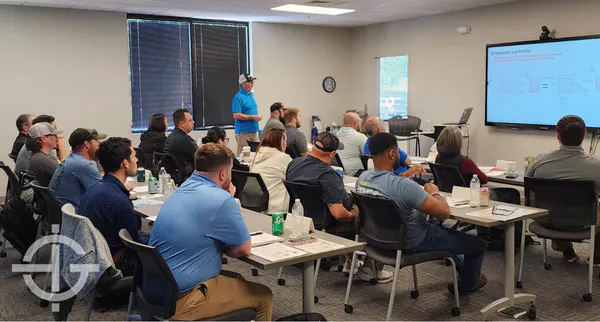
In a public training, you're sitting next to engineers, machinists, and quality techs from aerospace, medical devices, automotive, and contract manufacturing. Their questions are different. Their constraints are different. Hearing those questions often unlocks understanding you didn't know you were missing.
It forces you to think about GD&T as a shared language, not just a set of internal rules. That shift is underrated.
It's faster and lower-risk than most training alternatives.
Private company training is great. It can be customized, built around your drawings and your processes. But it takes time to coordinate, requires internal prep, and usually involves a bigger approval conversation.
Public training sidesteps most of that. No minimum headcount. No internal coordination. No need to develop materials. You pick a date, register, and show up.
For one or two people — a new hire, someone moving into a new role, an engineer who needs to level up before a critical project — it's almost always the faster path.
It's not online training. That distinction matters.
Online courses are flexible and great for reference. But if you've watched someone "complete" a module by clicking through slides while half their brain is somewhere else, you already know the limitation.
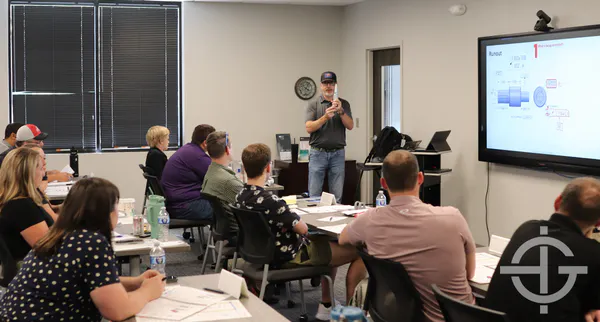
Public training is live, instructor-led, with real-time Q&A from someone who can tell the difference between a tolerance that's technically correct and one that's going to cause a problem on the shop floor.
When you register for a GD&T Basics public session, you also get a full year of access to the online course and direct instructor support. Live instruction as the foundation, online course as the reference to go back to when you're staring at a drawing six months later.
A smarter way to onboard new engineers.
Most new engineers learn GD&T by watching over someone's shoulder and absorbing whatever interpretation is floating around the office, correct or not. That's how bad habits form before anyone notices.
Getting a new hire into public training early is one of the highest-leverage things a manager can do. It builds a knowledge baseline fast, without pulling senior engineers away from their actual work or waiting on a custom training timeline to come together.
It scales in ways that don't get enough credit.
Teams change. People get promoted. Someone takes over a role that requires reading drawings they've never been trained on.
At GD&T Basics, five courses run throughout the year — Print Reading, GD&T Fundamentals, Advanced GD&T, Inspection GD&T, and GD&T Design. Virtual sessions run on half-day schedules so you're not blowing a full workday, with most courses offered multiple times a year. In-person sessions are full-day and hosted at partner locations for those who'd rather be in a room with people.
Send one or two at a time, rotate through the year, and you've trained the whole team without a single production disruption.

It also helps you figure out whether company-wide training is actually the right move.
Companies often reach out assuming they need custom, company-wide training. But after one conversation, it becomes clear they have mixed needs: some people need foundational knowledge, others need advanced courses, and not everyone needs the same thing at the same time.
Public training surfaces that quickly. It builds knowledge, highlights real gaps across departments, and often points toward a phased approach: public training now, custom training later when the need becomes more defined.
It doesn’t have to be an either-or decision. The two work well together.
The bottom line.
Public training isn't a consolation prize for teams that can't make custom training work. It's a different tool entirely. Faster to access, easier to approve, lower coordination burden, and in many situations, exactly the right fit.
If you've been waiting for the "right time" to start training, there probably isn't one. There's just the next public training waiting on the calendar.
We have courses running throughout the year — Print Reading, GD&T Fundamentals, Advanced GD&T, Inspection, and Design — available virtually and onsite.
