
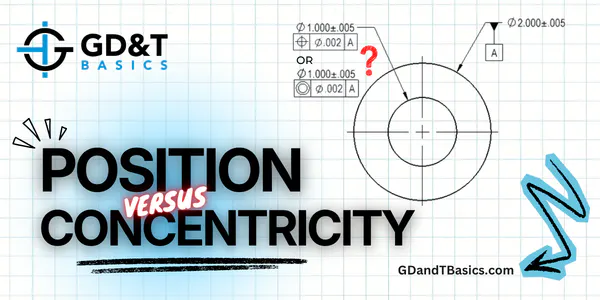

In this Question Line video, Jason answers the following question regarding Position vs ASME Concentricity:
When a cylindrical part with 2 coaxial features is measured to get the true position and concentricity, will the results be the same?
To answer this question, Jason focuses specifically on ASME concentricity, which is defined differently than its ISO counterpart. (For more information on how ISO concentricity compares to position, watch this video: Coaxiality vs Concentricity vs Position.)
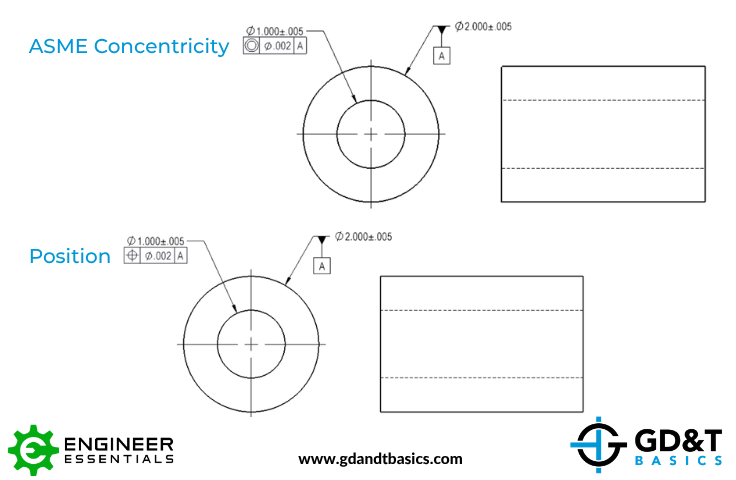
Jason discusses two similar drawings of a hollow cylindrical part, shown above. In both drawings, the outside diameter is defined as Datum Feature A, and the inner diameter is controlled relative to Datum A. However, the inner diameter is controlled by position in one drawing and by concentricity in the other. He explains that both controls are trying to align the center of the inner diameter with the center of the outer diameter, but go about this in different ways.
To illustrate the difference, Jason walks through three manufactured part scenarios:
- A part where the inner and outer diameters are not coaxial
- A part where the OD and ID are aligned, but the inner diameter has poor form
- A part where the inner diameter has a tri-lobed shape
For each case, he explains how the derived axis or median points of the inner diameter are determined and compares the position and concentricity deviation values. Jason wraps up by explaining the key difference between position vs ASME concentricity, and the best approach for the intended function of the part.
Do you have a GD&T question for our experts? Submit it at the link below:
https://www.gdandtbasics.com/share-your-gdt-questions/
If your question is selected, we will notify you when our video answer is posted to our YouTube channel.
* If you are a current student, reach out to us directly and we will get you into contact with your instructor. Active students’ questions receive a direct response within 24-48 hours.
The one-page GD&T reference that you will use every day
A visual breakdown of every core GD&T symbol and what it controls, all on one page. Bookmark it. Print it. Actually use it.
Download the Chart