We're exhibiting at IMTS 2026 — Booth #134034, Sept 14–19. Come see us in Chicago.

Advanced GD&T

Expand on your GD&T Fundamentals training to master the application of all GD&T symbols and callouts.

While the GD&T Fundamentals course teaches a core framework for understanding GD&T, the Advanced GD&T course builds upon this to give students a more comprehensive understanding of GD&T standards and their application. GD&T standards cover every manufacturing application across every industry, and this course fleshes out our Fundamentals course framework to show how GD&T is applied for better design for manufacturability.

Flexible Learning Options

Learn however is most convenient for you

Online Course

Self-paced learning with quizzes and on-demand videos – great for individuals or teams

Public Training

Live instructor-led public learning – in-person or virtually through live video conferencing

Custom Live Training

Customized training for your company – on-site at your facility or virtually through live video

Our GD&T Course Lineup

Whether you’re starting with the basics or diving deeper, choose the mix of courses that fits your goals.

GD&T training course options and the topics each course covers

Advanced GD&T, GD&T Inspection, and GD&T Design: Participants should have a basic understanding of print reading and must have completed GD&T Fundamentals (or equivalent) as a prerequisite.
It is also highly recommended to take Advanced GD&T prior to GD&T Design, but it is not required.

Course Objectives

By the end of this course, participants will be able to:

  • Expand upon the topics learned in the GD&T Fundamentals Course to understand advanced GD&T controls.
  • Understand composite controls for position and profile tolerances and why they are beneficial.
  • Learn cost saving techniques that benefit manufacturing processes and inspection.
  • Learn functional gauge design principles for inspection and understanding limits of a part.
  • Learn how advanced datum feature controls are to be interpreted and applied in measurement.
  • Design components with tolerances required to guarantee assembly while giving maximum amount of tolerancing to manufacturing.
  • Perform boundary tolerance calculations on parts to detect minimum and maximum limits.
  • Gain a full understanding for industry specific topics in the ASME Y14.5 that you may come across on your prints.

Who it is for

Our Advanced GD&T Training focuses on implementing and interpreting GD&T with an emphasis on design for manufacturing. This course is for anyone looking to expand upon their fundamental knowledge of GD&T.

Pre-Requisites

Participants should have a basic understanding of print reading and must have completed GD&T Fundamentals (or equivalent) as a prerequisite. This course focuses on application of GD&T and builds upon the students’ existing fundamental understanding of GD&T concepts.

*If you have already registered for our GD&T Fundamentals course and are now interested in adding on the online advanced course, please contact us to request registration.

Explore the Advanced GD&T Course Content

Our Advanced GD&T course builds on our Fundamentals framework to show how GD&T is applied for better design for manufacturability.

Unit 1: Revisiting Datums

  • Datums Features and Simulators Review
  • Using Patterns as Datums
  • Datum Translation & Movable Targets
  • Non Rectangular & Irregular Datums

Unit 2: Datum Modifiers and
Functional Gaging

  • Max Material Boundary (MMB) & Datum
    Modifiers
  • Simultaneous Requirements
  • Position Gaging Example
  • Functional Gaging Basics

Unit 3: Composite Tolerances

  • Composite Position
  • Multiple Single Segment
  • Composite Profile

Unit 4: Hole and Fastener Design

  • Projected Tolerance
  • Fixed Fastener Calculation
  • Floating Fastener Calculation
  • Zero Tolerance at MMC
  • Hole Process Tolerancing

Unit 5: Envelope and Boundary
Tolerance Formulas

  • Envelopes and Boundaries at RFS
  • Tolerance Calculations with RFS
    Boundaries
  • Virtual Condition Review
  • Resultant Condition Calculation
  • VC/RC Tolerance Calculations

Unit 6: General Advanced Symbols
and Concepts
  • Tangent Plane Symbol
  • Statistical Tolerancing Symbol
  • Restrained & Free State Callouts
  • Non-Uniform Profile Segments

Watch a Sample Lesson from the Online Course

Advanced GD&T Course - FAQs

  • Do I really need the Fundamentals course first?

    Our Advanced GD&T course builds directly on the concepts taught in GD&T Fundamentals. It assumes you already have a solid understanding of basic GD&T and focuses entirely on applying more advanced tools in design, inspection, and manufacturing.

    Unlike the Fundamentals course, Advanced does not review basic concepts like symbols, datums, or feature control frames. Instead, it dives into topics like:

    • Composite tolerancing for position and profile
    • Advanced datum feature interpretation
    • Boundary calculations
    • Functional gaging
    • Design for manufacturability and inspection efficiency

    Because of this, we require that all participants complete our GD&T Fundamentals course (or an equivalent) before enrolling in Advanced. If you skip that foundation, the advanced topics can quickly become confusing — which can lead to a frustrating and ineffective training experience.

    • We’ve seen this firsthand: when attendees jump into Advanced without the right foundation, they often tune out, miss the core takeaways, and walk away with very little benefit. That’s a waste of your time, your team’s energy, and your training budget.
  • How is this course different from the Fundamentals course?

    The Advanced course builds directly on the concepts taught in our GD&T Fundamentals course. While Fundamentals focuses on interpreting core GD&T concepts, Advanced is all about applying them to more complex designs and inspection situations.

    It covers topics like composite tolerancing, boundary calculations, functional gaging, and advanced datum interpretation — and assumes you already have a strong foundation in basic GD&T.

    For that reason, we recommend completing Fundamentals first to ensure the best possible learning experience.

    Without that foundation, Advanced topics can quickly become overwhelming and less impactful.

  • What’s covered in the Advanced course?


    The Advanced GD&T course builds on the foundation taught in our Fundamentals course and focuses on how to apply GD&T to more complex design, inspection, and manufacturing scenarios.

    Topics include:

    • Composite tolerancing for position and profile
    • Advanced datum feature interpretation, including irregular shapes and movable targets
    • Functional gaging principles to support efficient and reliable inspection
    • Fixed and floating fastener calculations
    • Hole process tolerancing and projected tolerance zones
    • Boundary and envelope tolerance formulas, including virtual and resultant condition
    • Advanced GD&T symbols and applications, such as tangent planes, free and restrained state callouts, and statistical tolerancing

    We also introduce the core concepts behind tolerance stack-ups, particularly how GD&T tools like composite tolerances, fastener formulas, and boundary conditions influence part-to-part variation. However, this is not an in-depth tolerance stack-up course.

    If you're looking for a deeper dive into stack-up analysis and vector-based methods, we’re currently developing a design-focused GD&T course that will explore this topic in greater detail — expected to launch by the end of 2026.


  • What types of companies or industries benefit most from Advanced GD&T?

    The Advanced GD&T course is ideal for companies and teams that design, inspect, or manufacture complex parts and assemblies — especially where tight tolerances, functional gaging, or design optimization are critical.

    Industries that benefit most include:

    • Aerospace & Defense
    • Automotive & EV Manufacturing
    • Medical Device & Equipment
    • Industrial Machinery
    • Precision Manufacturing
    • Electronics/Enclosures
    • Oil & Gas / Energy

    This course is built for experienced designers, engineers, and inspectors who already understand core GD&T concepts and want to apply them more strategically — whether to improve manufacturability, reduce cost, or tighten process control.

    If your team needs to move beyond reading GD&T and start using it to solve real design and production challenges, this course is the next step.

  • Will I get hands-on practice or is it just theory?

    This course is highly applied — but not "hands-on" in the sense of physical labs.

    You’ll work through:

    • Real-world drawing examples that show how advanced GD&T appears in practice
    • Step-by-step tolerance calculations and boundary evaluations
    • Real-world print examples and animations that connect theory to real part behavior
    • Exercises focused on design for manufacturability and inspection

    While you won’t be using tools or measuring parts directly, you’ll build practical skills that can be applied to design reviews, inspection planning, and process optimization immediately.

  • How does this help me in my current job?

    Advanced GD&T helps you go beyond reading drawings — and start using GD&T as a design, inspection, and manufacturing optimization tool.

    You’ll learn how to:

    • Design parts that ensure fit and function while opening up tolerance for easier manufacturing
    • Reduce scrap, rework, and miscommunication caused by unclear or overly tight tolerances
    • Make design decisions with clear justification using advanced GD&T controls
    • Communicate more effectively with inspection and manufacturing teams — backed by standards, not guesswork

    Whether you’re creating drawings, reviewing them, or trying to hit tolerances on the shop floor — this course helps you make better, faster, and more informed decisions.

  • How long does the course take?

    That depends on the training format:

    • Online, self-paced: Most students complete the Advanced course in 10–12 hours total. The course is bundled with GD&T Fundamentals, but this estimate is for the Advanced portion only. You’ll have 1-year access, so you can learn at your own pace and revisit materials anytime.
    • Live (virtual or on-site): Typically delivered over 1.5 to 2 days, depending on your team’s needs and schedule.
      If your team completes GD&T Fundamentals immediately before Advanced, the full training can be streamlined.
      If there’s a gap between Fundamentals and Advanced, we may extend the session slightly to allow time for refresher content and review before diving into advanced topics.
    • We’re happy to tailor the format based on your team's experience level and goals.
  • Who should take the Advanced course?

    This course is for professionals who’ve already mastered the GD&T basics and are ready to apply advanced concepts to real-world scenarios.

    You’ll get the most value if you are a:

    • Mechanical or design engineer working on tight-tolerance assemblies
    • Inspector or quality professional interpreting complex callouts
    • Manufacturing engineer or lead machinist dealing with GD&T-driven production decisions
    • Tooling or gage engineer responsible for verifying part features
    • Supervisor or technical lead needing to review and improve team drawings

    If you want to improve part quality, reduce unnecessary cost, and strengthen cross-team communication — this course is for you.

  • What support is included after the course?

    We’re here to help you apply what you’ve learned — not just finish the course.

    • If you enroll in the online course, you’ll have full access to the learning platform for 1 year after enrollment. Even after you complete the training, you can revisit the lessons anytime for review or as a reference on the job.
    • If you complete the course with a live instructor, you’ll receive 90 days of platform access after the training wraps up — including everything available in the online version.

    Included with both formats:

    • Access to previously recorded webinars and bonus video content
    • Extra practice examples and tips
    • Direct email support from certified GD&T instructors for real-world questions

    Whether you're reviewing a concept for a project or facing a tricky drawing at work, we’re here to help long after the course ends.

Still not sure which GD&T training option is best for your team?

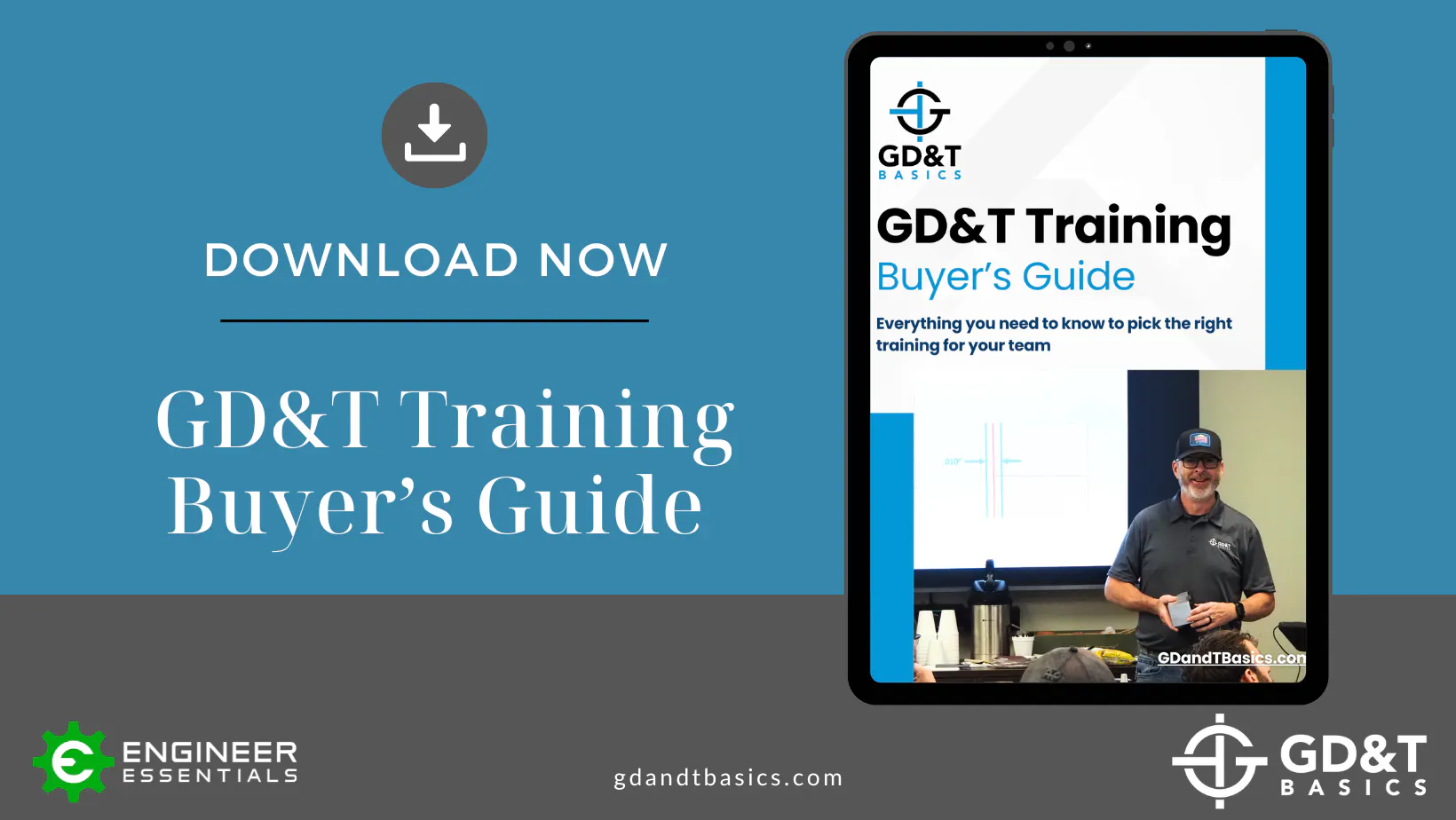
Download our free guide to choosing the right GD&T team training to compare your options.