

Buying GD&T training isn’t something most teams do often.
But when you get it wrong, it’s expensive. Lost time, frustrated engineers, and the same drawing issues still showing up after the training is over.
Here’s the part most teams don’t think about. The people selling training have done this hundreds of times. Most buyers haven’t. That difference in experience is exactly how you end up with training that looked right on paper but missed the mark entirely.
Here are the questions worth asking before you commit.
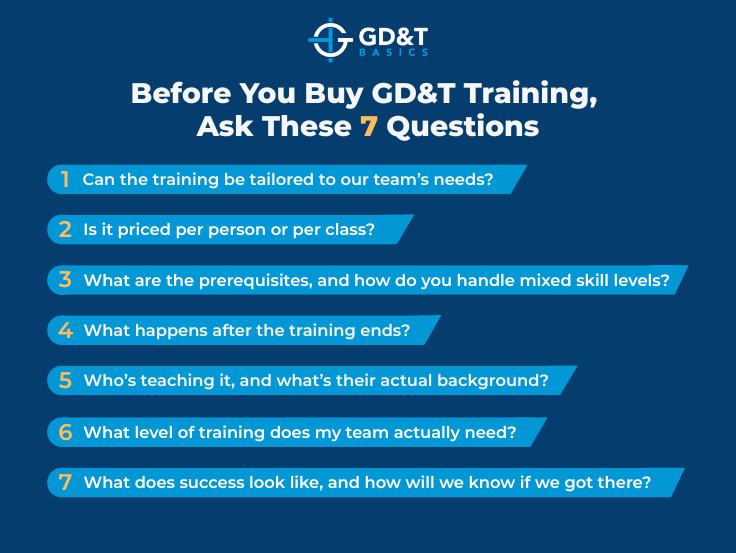
Can the training be tailored to focus on what matters most to our team?
This is the first question to ask for any live training.
There’s a big difference between a trainer who shows up with a generic slide deck and one who takes the time to understand your team before the training even starts.
Strong training should be flexible in how it’s delivered. The core course stays consistent, but the focus should shift based on your team. The topics emphasized, the examples used, and the time spent on each concept should reflect your roles, your challenges, and how your team is using GD&T day to day.
Ask specifically: Can the training be adjusted to focus on the topics that matter most to our team? How do you tailor the delivery of the course based on our roles and challenges?
Is it priced per person or per class?
This one changes the math significantly, and most people don’t think to ask it upfront.
Some training is priced per seat, meaning costs scale with your headcount. Other formats, like custom on-site training, are priced as a flat rate per class up to a certain number of participants.
For larger teams, that flat rate can be a much better deal than it looks at first glance.
Know which model you’re dealing with before you start comparing apples to oranges.
What are the prerequisites, and how do you handle mixed skill levels?
This is where good training can fall apart fast.
If your team has a mix of experience levels, and most do, putting everyone in the same session creates tension. The experienced people check out. The newer ones can’t keep up. The instructor ends up trying to split the difference, and nobody really wins.
Ask how the provider handles this. Do they recommend splitting groups? Assess attendees ahead of time? Offer prerequisite training?
A good provider will push back if the group isn’t set up for success. A bad one will run the class as-is and hope for the best.
What happens after the training ends?
The training days are the easy part. What happens the following Monday is what matters.
Someone’s going to be staring at a drawing thinking, “Wait… how do I interpret this again?”
Ask about post-training support. Is there instructor access? Online resources? A way to ask questions? Continued access to materials?
The goal isn’t to get through the session. It’s to actually change how your team works, and that usually requires reinforcement. Without it, you’re back where you started in a few weeks. With it, the training actually carries into day-to-day work.
Who’s teaching it, and what’s their actual background?
Certifications matter. Real-world experience matters more.
An ASME-certified instructor who’s spent years in manufacturing is going to teach GD&T differently than someone who learned it from a textbook. You’ll see it in the examples they use, the questions they can answer, and how they connect the standard to what actually happens on the shop floor.
Ask about your instructor specifically, not just the company’s credentials in general.
What level of training does my team actually need?
We see this mistake all the time.
Teams ask for advanced training when what they actually need is fundamentals. On the surface, it makes sense. These are experienced people. They’ve been working with drawings for years, so the assumption is, “we’re past the basics.”
But when you start digging in, those basics aren’t as solid as everyone thinks. There are gaps, misunderstandings, and things that have just been “good enough” for a long time.
GD&T is one of those subjects where you don’t know what you don’t know. And those gaps don’t stay small.
If the foundation isn’t there, advanced training doesn’t fix the problem. It just builds on top of it. Get this wrong, and your team walks out of training just as confused as they walked in.
What does success look like, and how will we know if we got there?
This is the question most people skip, and it’s one of the most important ones.
Training without a defined outcome is just a scheduled event. Before you buy anything, get clear on what you’re actually trying to fix. Fewer drawing disputes? Faster inspection? New hires getting up to speed without six months of on-the-job guessing?
The clearer you are about the problem, the easier it is to hold the training accountable for solving it.
Fewer NCRs. Less back-and-forth with suppliers. Inspectors and designers speaking the same language. Pick the one that matters most to your team and use it to evaluate whether the training actually delivered.
The bottom line
A vendor who can answer these questions clearly, and who takes the time to understand your team before making a recommendation, is probably worth your time. One who can’t, or who just tells you what you want to hear, is a red flag.
If you want a head start, our GD&T Training Buyer’s Guide gives you the format comparisons, pricing breakdowns, prerequisites, and course-by-course details to evaluate your options and choose the right fit for your team.
Download the GD&T Training Buyer’s Guide
The one-page GD&T reference that you will use every day
A visual breakdown of every core GD&T symbol and what it controls, all on one page. Bookmark it. Print it. Actually use it.
Download the Chart