We're exhibiting at IMTS 2026 — Booth #134034, Sept 14–19. Come see us in Chicago.

Print Reading and Tolerances

An essential course for confidently reading and interpreting engineering prints.

In the Print Reading and Tolerances Course, you will learn to read, interpret, and understand real engineering drawings. We break down the complexities of engineering drawings into key concepts that apply to every print, using a mix of documented standards, shop floor knowledge, and real-world examples. This introductory course equips you to work with actual engineering drawings by teaching a proven process to interpret prints the right way every time.

Flexible Learning Options

Learn however is most convenient for you

Online Course

Self-paced learning with quizzes and on-demand videos – great for individuals or teams

Public Training

Live instructor-led public learning – in-person or virtually through live video conferencing
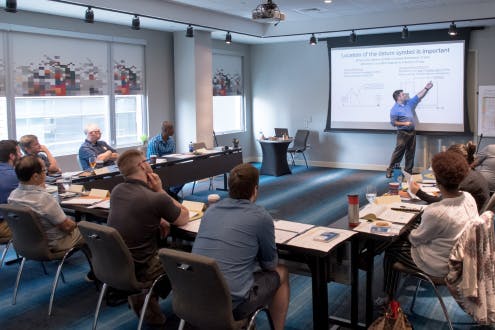
Custom Live Training

Customized training for your company – on-site at your facility or virtually through live video

Our GD&T Course Lineup

Whether you’re starting with the basics or diving deeper, choose the mix of courses that fits your goals.
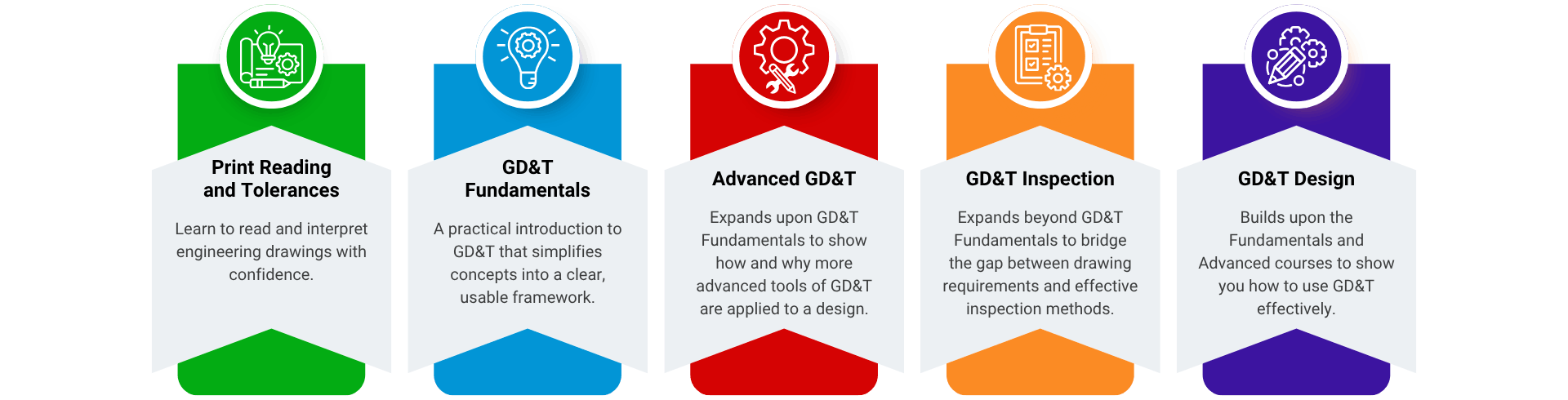
GD&T training course options and the topics each course covers

Advanced GD&T, GD&T Inspection, and GD&T Design: Participants should have a basic understanding of print reading and must have completed GD&T Fundamentals (or equivalent) as a prerequisite.
It is also highly recommended to take Advanced GD&T prior to GD&T Design, but it is not required.

Take our quiz to see if you're a Print Reading Expert!

This quiz will show if you know how to interpret the basic components of most prints.

Course Objectives

By the end of this course, participants will be able to:

  • Recognize and understand the most common symbols found on engineering drawings
  • Identify the pertinent manufacturing information on a print, such as units of measure, general tolerances, revision history, bill of material, and other critical data
  • Decipher different dimensioning methods used on engineering drawings to determine what dimensional tolerances really mean
  • Interpret various views and line types on 2D drawings to visualize the full geometry of a part or assembly in 3D

You’ll leave this course equipped to read, interpret, and understand real engineering drawings—and empowered to work more confidently, communicate more clearly, and produce parts more efficiently.

Who it is for

Anyone who works with prints or makes decisions with them, regardless of technical background, can benefit from Print Reading and Tolerances. Our course is approachable at any level, with no previous print reading experience required.

Our Print Reading and Tolerances course is ideal for:

  • Entry-level Designers
  • Inspectors and Inspection Planners
  • Sales and Purchasing Professionals
  • Entry-level Engineers
  • Machinists and Operators
  • Managers and Supervisors
  • Production Associates
  • And anyone else who works with engineering prints

Explore Print Reading & Tolerances Course Content

Learn to read and interpret engineering drawings with confidence.


Section 1: Drawing Information
System

  • The Two Types of Drawings
  • Goal of an Engineering Drawing
  • Most Important Parts of a Drawing
  • Field of View
  • Title Block
  • General Drawing Notes
  • Revision Block
  • Bill of Materials

Section 2: Drawing Visualization
System

  • Part Geometry Lines
  • Orthographic Views - Viewing 2D to 3D
  • Orthographic View - Exercises
  • Common Drawing Views
  • Section Views
  • Descriptive Dimensioning Lines

Section 3: Special Requirement
Callouts

  • General Drawing Symbols & Callouts
  • Holes & Threads
  • Roughness & Hardness
  • Fundamental Welding Symbols

Section 4: - Tolerancing System
  • Introduction to Tolerances
  • Metric vs Inch
  • Dimensional (±) Tolerances
  • Dimensioning Methods
  • Dimensional Tolerance Examples
  • The Basics of GD&T
  • GD&T Examples

Watch a Sample Lesson from the Online Course

Print Reading and Tolerances Course - FAQs

  • What will I learn in this course?

    You’ll learn how to confidently read and interpret real-world engineering drawings — no prior experience required. That includes:

    • Understanding the most common symbols used on prints
    • Decoding dimensional tolerances and what they actually mean for manufacturing
    • Identifying key drawing details like units, notes, revisions, and BOMs
    • Reading 2D views to visualize 3D parts and assemblies

    By the end, you’ll know how to take any print and interpret it the right way— without second guessing.

  • Who is this course for?

    This course is for anyone who needs to understand engineering drawings — not just engineers. If prints are part of your work, this course is for you.

    Past students include:

    • Entry-level engineers, designers, and operators
    • Inspectors and planners
    • Sales, quoting, and purchasing teams
    • Anyone involved in quoting, machining, inspecting, or managing

    If you’ve ever thought, “I’m not 100% sure what this drawing is telling me,” this course will fix that.

  • Do I need this course before taking GD&T Fundamentals?

    If you’re not already confident reading prints, then yes — this course is the best foundation before moving into GD&T Fundamentals. It ensures you’re comfortable with dimensions, tolerances, and drawing basics so you can focus on GD&T without confusion.

  • How long is the course, and what’s the time commitment?


    The Print Reading & Tolerances online course takes about 8–12 hours total to complete — including lessons, quizzes, and the final exam.

    If you spend just 30 minutes a day, you can finish the course in 2–3 weeks — or you can move through it faster if you prefer. It’s completely self-paced.

    If you’re completing this course through a live instructor (virtually or on-site), the training is delivered in a focused format that takes about 1.5 days. Live participants also receive 90-day access to the online learning platform for follow-up practice and review.

    Those who enroll in the online-only course get 1 full year of access to access the material anytime.


  • How much does it cost, and is it worth it?

    The online course costs $199 per person and includes:

    • All Print Reading lessons, quizzes, and print reading examples
    • 1 year of access to the learning platform
    • Instructor email support
    • Certificate of completion

    We also offer live instructor-led training for teams (virtual or on-site). Pricing for live delivery depends on group size and location — contact us for a quote and we’ll help you find the best fit.

    Is it worth it? Absolutely. If you work with prints and want to stop second-guessing what you’re looking at, this course gives you the confidence and clarity you need — saving time, avoiding mistakes, and helping you make smarter decisions every day.

  • Is the content aligned with industry standards?

    Yes. The course is built on documented standards (like ASME) but also incorporates shop floor knowledge and real-world examples, so you’re learning both the rules and how they’re applied in practice.

  • Will I get practice or is it just theory?

    You’ll work with real-world drawing examples and practice applying what you learn. The course uses a mix of guided lessons, examples, and exercises designed to build confidence and retention.

  • How does this help me in my current job?

    Being able to read a print without confusion saves time, avoids costly mistakes, and builds trust across teams. After this course, you’ll:

    • Communicate more clearly across departments
    • Make faster decisions with fewer errors
    • Reduce production delays due to drawing misinterpretations

    Whether you’re on the shop floor, in a meeting, or sending a quote — you’ll be more confident.

  • What support is available after the course?

    All students receive 90-day access to our online learning platform, including bonus video lessons and recorded webinars. You’ll also have direct email support from our certified instructors if you have questions on the job.

Still not sure which GD&T training option is best for your team?

Download our free guide to choosing the right GD&T team training to compare your options.